

BLUF
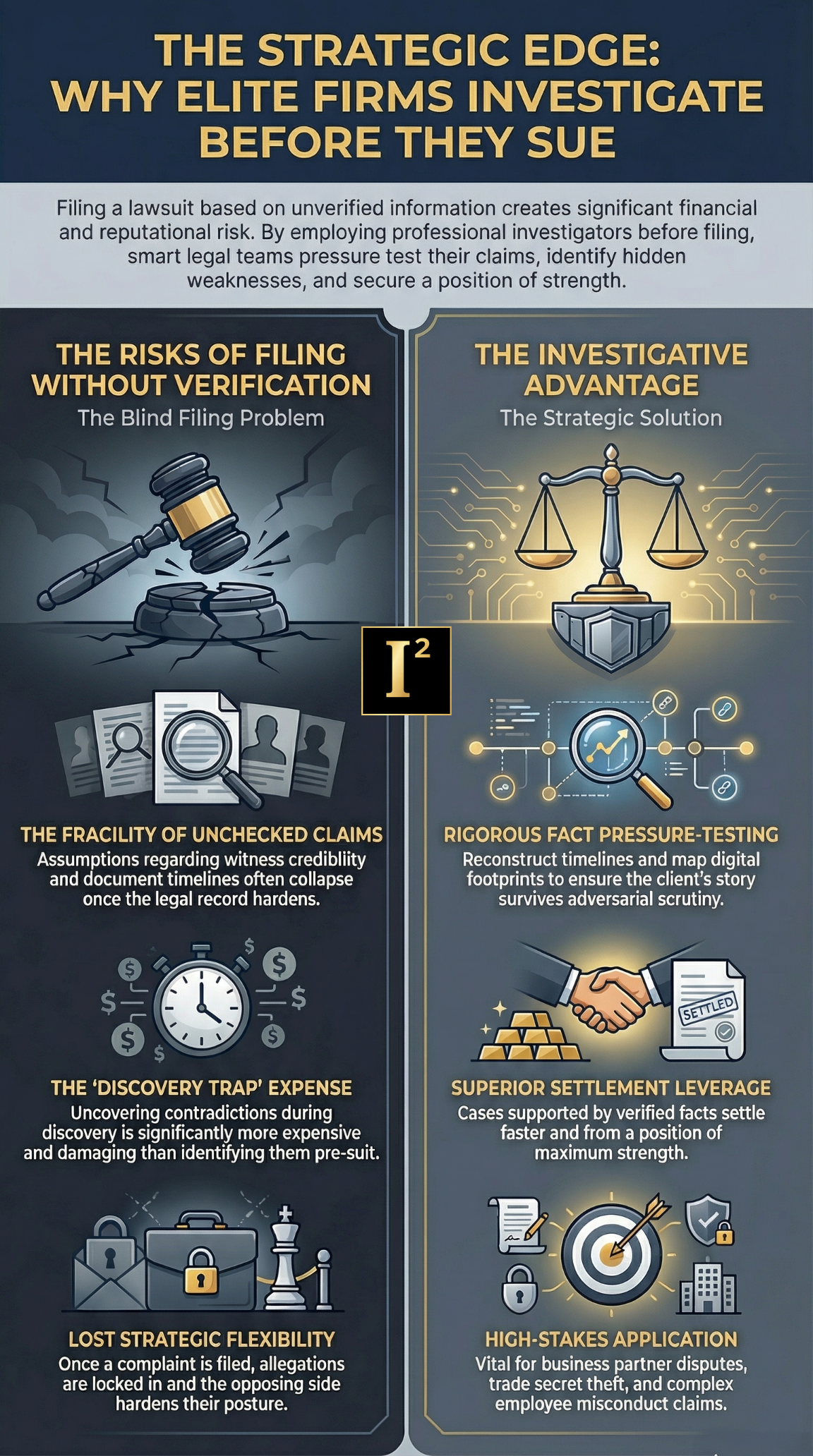
Filing first and chasing facts later is how cases get weak, expensive, and exposed. Smart attorneys use investigators before suit to test claims, pressure-check witnesses, verify timelines, uncover hidden risks, and build leverage before the other side has a chance to shape the story.
The biggest mistake in civil litigation starts before the complaint
A lot of cases look strong in the first meeting.
The client sounds credible. The documents seem persuasive. The timeline feels clean. The story has emotional force.
Then the real world shows up.
A witness disappears. A social media post contradicts the claim. A business relationship nobody mentioned changes the entire theory. A “key fact” turns out to be assumption, not proof.
That is where cases start to break.
The problem is not always bad lawyering. The problem is often bad factual ground. If the facts are not stress-tested before filing, the case can get expensive fast.
That is why strong attorneys do not rely only on what they are told. They verify. They pressure test. They investigate.
Why pre-suit investigations matter
A pre-suit investigation gives counsel something far more valuable than confidence. It gives clarity.
Before a complaint is filed, there is still room to move. Strategy is flexible. Allegations are not locked in. The other side may not even know what is coming.
That window matters.
A good investigator helps counsel answer the questions that actually decide whether a case should be filed, narrowed, settled, or abandoned. Those questions include:
Is the client telling the full truth?
Not the polished version. Not the angry version. The full version. Investigators can identify inconsistencies, missing facts, prior relationships, outside motives, digital contradictions, and witness problems before those issues blow up in discovery.
Can the claim actually be proven?
A claim that sounds compelling is not the same as a claim that can survive scrutiny. An investigation helps determine whether there are witnesses, records, surveillance, public data, digital evidence, or other facts that support the theory.
What will the other side say when hit?
This is where many cases get ambushed. The best time to identify defenses, counterclaims, credibility attacks, and reputational issues is before filing, not after the response lands.
Is there leverage beyond the pleading?
Litigation is not just about being right. It is about positioning. Facts create leverage. Verified facts create stronger leverage. When counsel walks into a demand, negotiation, injunction request, or complaint with real investigative support, the case hits differently.
What investigators can uncover before a lawsuit is filed
A serious pre-filing investigation is not just “background research.” It is a structured effort to find what matters before the record hardens.
- Witness location and witness assessment: Some cases depend on one person. That is dangerous. Investigators can locate former employees, vendors, neighbors, business associates, or third parties who may confirm, challenge, or complicate the claim. Just as important, they can help assess whether that witness is solid, shaky, evasive, hostile, or compromised. That changes strategy.
- Timeline reconstruction: Many cases rise or fall on sequence. Who knew what. When they knew it. Who met with whom. Who sent the message. Who was present. Who moved money. Who accessed the data. A reconstructed timeline often reveals the part nobody wanted examined too closely.
- Digital footprint review: People talk with their phones, social profiles, reviews, business records, cached pages, public filings, and online behavior. A digital investigation can expose contradictions between what a party says in private and what they show in public. That can matter in employment disputes, fraud claims, business breakups, unfair competition, custody matters, and infidelity-linked litigation.
- Background and relationship mapping: Cases are rarely as isolated as they first appear. An investigator may uncover undisclosed personal ties, shell entities, prior lawsuits, hidden business interests, old complaints, reputation issues, or conflicts that shift how the case should be framed.
- Surveillance and field verification: In the right matter, surveillance can help test claims tied to activity, behavior, movement, meetings, or routine. Used lawfully and strategically, it can confirm facts or destroy assumptions before counsel commits to a filing position.
Why this matters to attorneys
Attorneys are paid to exercise judgment. That judgment gets stronger when it is grounded in facts no one else took the time to verify. A pre-suit investigation helps lawyers:
- Avoid filing weak claims: The best case to avoid is the one that never should have been filed.
- Draft stronger complaints: Specific facts hit harder than broad accusations.
- Reduce surprise in discovery: Surprise is expensive.
- Pressure test client credibility: Not every client lies. Some omit. Some distort. Some misunderstand. That still hurts the case.
- Improve settlement posture: A well-investigated matter often settles from a position of strength because the other side senses the difference.
Why this matters to companies and decision makers
General counsel, business owners, HR leaders, insurers, and executives face the same problem from a different angle. They are often asked to act on incomplete facts: file suit, respond to allegations, fire the employee, cut the vendor loose, escalate to regulators, or take a public position.
That is risky when the real story has not been established. An independent investigation helps decision makers act from evidence, not emotion.
Common situations where pre-filing investigations pay off
These are the matters where early investigation often changes the outcome:
- Business partner disputes: The story usually starts with betrayal and ends with money, records, hidden communications, or undisclosed side deals.
- Employee misconduct claims: Especially when the allegations involve harassment, retaliation, theft, misuse of company assets, or insider activity.
- Fraud and financial misconduct matters: When something feels off in billing, procurement, reimbursements, vendor activity, or executive conduct.
- Trade secret and IP disputes: Because proprietary information rarely leaves cleanly and the facts move fast.
- Insurance and disability claims: When the issue is whether the claim matches actual conduct.
- High-conflict family or infidelity-related matters: Because behavior, routine, cohabitation, and digital footprints often matter more than statements.
The danger of filing too early
Once a complaint is filed, several things happen at once:
- The other side gets alert.
- Records move.
- Stories tighten.
- Witnesses get coached.
- Posture hardens.
- Leverage shifts.
Sometimes filing is necessary and urgent. But when there is time to investigate first, that time should be used well. Because after filing, you are no longer just developing facts. You are fighting over them.
What good investigative support looks like
The best investigative partner does not create noise. They create usable facts. That means:
- Clear reporting
- Legally sound methods
- Fast issue spotting
- Strong documentation
- Discretion
-
Understanding what attorneys need and what decision makers can act on
This is not about theatrics. It is about disciplined fact development.
Bottom line
Before you sue, know what is real.
- Know whether the witness holds up.
- Know whether the client’s story survives pressure.
- Know whether the timeline works.
- Know whether the digital trail helps or hurts.
- Know whether the other side has a defense you have not seen yet.
Smart attorneys do not wait for discovery to learn what they should have known before filing. They investigate early, work with facts, and build cases that hold together under pressure.
That is not overkill. That is how serious cases are built.