

BLUF
Most due diligence failures do not occur because no one looked. They happen because people looked too narrowly, trusted what was handed to them, missed the relationships that mattered, and moved too fast to challenge the story. When that happens, companies inherit lawsuits, fraud exposure, hidden conflicts, reputational damage, and financial loss that could have been identified before the deal, hire, partnership, or investment ever moved forward.
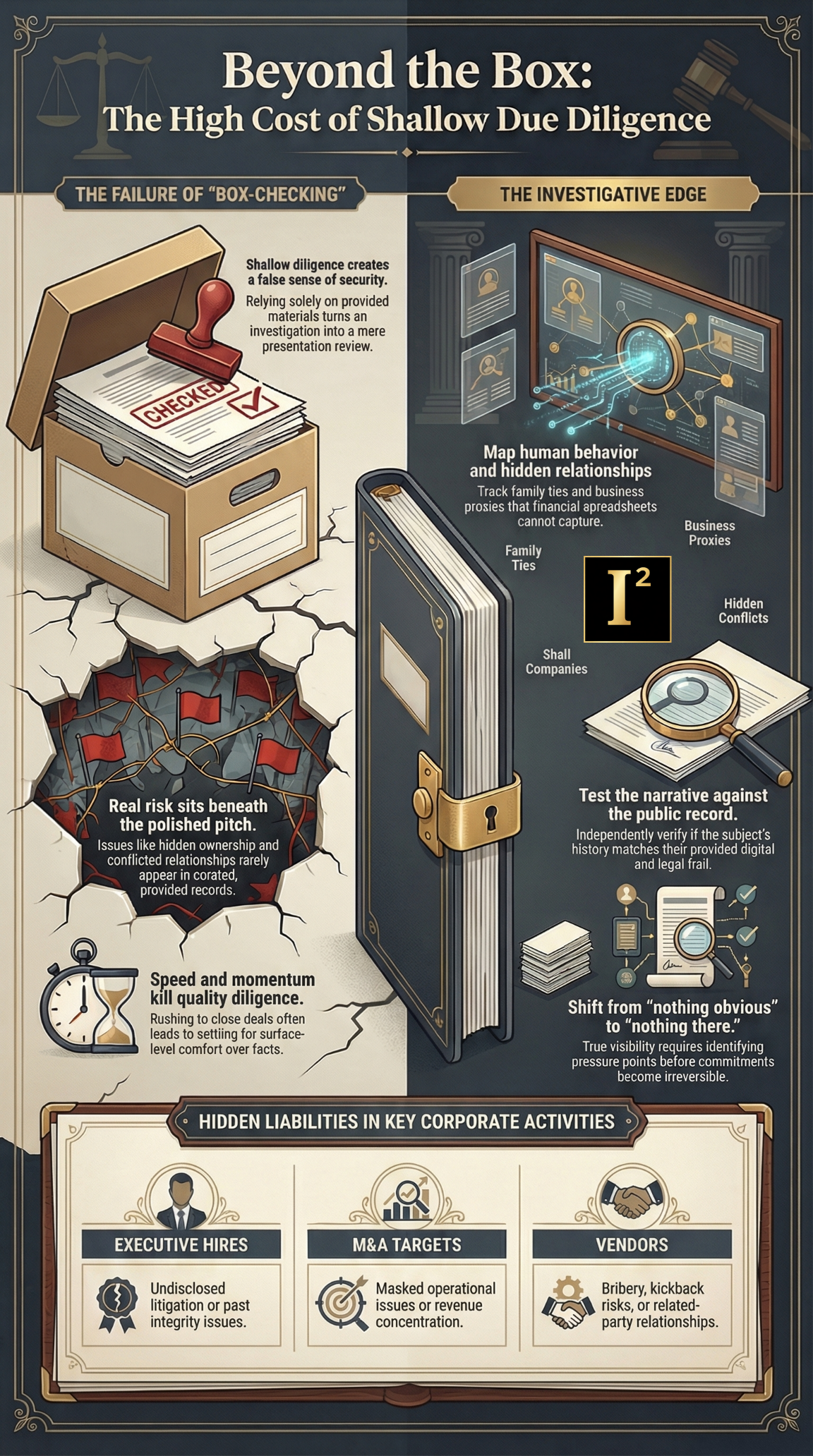
Bad due diligence is expensive in ways most companies do not see coming
A lot of decision makers think due diligence is a box to check.
Run the background check. Review the documents. Confirm the entity exists. Look at the financials. Search for obvious litigation. Get comfortable enough to move.
That feels responsible.
Sometimes it is nowhere close to enough.
Real risk rarely sits in the first layer. It sits underneath the polished pitch, the curated records, the carefully managed references, and the parts of the story nobody volunteered because nobody forced them into the light.
That is where companies get burned.
Not because they did nothing.
Because they did too little.
Due diligence fails when it becomes a paperwork exercise
This is the core problem.
Many diligence efforts are built to confirm, not to challenge.
The questions are narrow.
The records are limited.
The timeline is rushed.
The review is shaped around getting to yes.
That creates a false sense of security.
On paper, everything looks fine.
In reality, the company may be walking into:
Undisclosed litigation
Hidden ownership interests
Conflicted relationships
Regulatory exposure
A partner with a history of misconduct
A vendor tied to someone inside the company
A senior hire with past integrity issues
A target business built on shaky representations
A reputation problem already known in the market but not in the file
That is the cost of shallow diligence.
Why companies miss what matters
They rely too heavily on what is provided
This is one of the biggest mistakes.
If your diligence depends mostly on what the subject gives you, you are not investigating. You are reviewing a presentation.
People and companies under scrutiny tend to provide the clean version. They do not lead with buried disputes, strained partnerships, undisclosed side interests, or facts that make the transaction less attractive.
That is why independent verification matters.
They focus on financials and ignore people
Financial review matters. Legal review matters. But many failures begin with human behavior.
Who is really involved.
Who has influence behind the scenes.
Who has prior issues nobody disclosed.
Who is tied to whom.
Who has a reputation for cutting corners.
Who quietly follows the same pattern from company to company.
A spreadsheet will not always tell you that.
An investigation might.
They do not map relationships deeply enough
A lot of damaging risk sits inside relationships.
Business partner connections.
Family ties to vendors.
Former executives working through proxies.
Conflicts of interest hidden through LLCs.
Consultants who are not really independent.
Employees with side arrangements.
Decision makers are steering work toward familiar channels.
These issues often do not look dramatic until money moves, control shifts, or litigation begins.
They move too fast
Speed kills good diligence.
The pressure to close the deal, make the hire, sign the contract, answer the board, satisfy the investor, or lock in the partner often compresses the one part of the process that should slow everything down.
That is when people settle for surface level comfort.
And surface level comfort is expensive.
The types of due diligence failures that do real damage
The executive hire that looked perfect on paper
The resume is strong.
The references sound polished.
The interview goes well.
The person says exactly what leadership wants to hear.
Then the problems start.
A pattern of prior conflict emerges.
Old litigation gets noticed too late.
A reputation for retaliation or dishonesty surfaces after the hire.
A conflict of interest was never disclosed.
A prior employer has a very different version of events.
Now the company is dealing with legal risk, morale damage, and a leadership problem it invited in.
The acquisition target with hidden problems
A target company may look solid from the outside while hiding serious issues underneath.
Revenue concentration that was downplayed.
Customer relationships that are weaker than presented.
Pending disputes not fully disclosed.
Operational issues masked by timing.
Compliance failures.
Ownership complications.
Side agreements.
Key people already planning to leave.
By the time the buyer sees the full picture, the money is already committed or the unwind is painful.
The vendor relationship that was compromised from the start
Vendor diligence is often treated as secondary. That is a mistake.
Some of the worst problems show up through third parties:
Inflated pricing
Undisclosed related party relationships
Questionable sourcing
Past fraud concerns
History of litigation
Financial instability
Bribery or kickback risk
Regulatory noncompliance
A vendor chosen because of loyalty, not merit
Once that vendor is embedded, the risk spreads into procurement, finance, operations, legal exposure, and reputation.
The partnership built on assumptions
Strategic partnerships often move fast because everyone wants the upside.
But if the diligence is weak, that upside can turn into dependency on the wrong company, the wrong people, or the wrong story.
The partner may not have the capabilities claimed.
The legal exposure may be larger than expected.
The internal culture may be toxic.
The financial pressure may be hidden.
The executives may have a track record nobody fully examined.
That is how companies end up tied to someone else’s mess.
What real due diligence should uncover
Good due diligence is not about perfection. It is about visibility.
It should help decision makers see what is actually there, not what was packaged for them to see.
That includes:
Background and reputation issues
Litigation history
Regulatory concerns
Ownership and control questions
Adverse media or public record signals
Business affiliations
Hidden relationships
Conflicts of interest
Past patterns of misconduct
Financial red flags tied to behavior
Operational inconsistencies
Digital contradictions
Market reputation that does not appear in formal materials
When diligence works, leadership makes decisions with open eyes.
When it fails, leadership pays to learn later.
Why investigative due diligence matters
Traditional diligence often stops where investigative diligence starts.
A professional investigation can test the story instead of simply organizing it.
That means looking beyond the provided records and asking:
Does the public record match the narrative
Are the people who appear independent actually connected
Does the executive’s history hold up under scrutiny
Are there patterns of dispute, misconduct, or reputational concern
Do timelines, statements, and business activity line up
Is there a digital trail that says something different
Are there relationships that should have been disclosed but were not
These are not small questions.
These are the questions that stop bad decisions.
The cost of getting it wrong
Bad due diligence does not only cost money at closing.
It keeps costing money after the decision is made.
The losses may come through:
Litigation
Regulatory inquiries
Fraud exposure
Internal disruption
Board scrutiny
Insurance issues
Reputational damage
Leadership instability
Contract loss
Operational setbacks
Expensive unwinds
Public embarrassment
In many cases, the biggest frustration comes later when someone says, “We could have found this.”
That is usually true.
What companies should stop doing immediately
Stop treating diligence like an administrative task.
Stop relying only on provided materials.
Stop assuming a clean presentation means a clean history.
Stop separating financial review from human risk.
Stop rushing because momentum feels good.
Stop confusing “nothing obvious” with “nothing there.”
That mindset is how companies inherit problems they never had to own.
What strong diligence looks like
Strong diligence is skeptical without being reckless.
It is disciplined.
It is independent.
It is focused on facts, not impressions.
It tests representations.
It maps people and relationships.
It looks for pressure points.
It identifies what could go wrong before the commitment is irreversible.
Most of all, it gives decision makers room to act before the risk becomes theirs.
Bottom line
Due diligence failures cost companies millions because bad facts are expensive and late facts are worse.
The real danger is not always in what was openly false. It is often in what was left out, buried, softened, or never examined hard enough to matter.
The companies that avoid those losses are not always smarter. They are just more willing to ask harder questions before they commit.
That is what good diligence does.
It protects capital.
It protects leadership.
It protects reputation.
It protects the company from buying, hiring, partnering with, or betting on a problem someone else already knew was there.
Before you commit capital, sign the agreement, or bring the wrong person into your business, know what you are walking into. Insight Investigations helps companies uncover hidden risks, undisclosed relationships, reputational concerns, and facts that could change the decision before the damage is done.