

Thousands of homes, commercial buildings, and rental properties across Western and Upstate New York still operate on electrical systems installed decades ago. That old wiring does more than create fire hazards. It creates a web of investigative, legal, and financial exposure that most property owners, insurers, and business operators never see coming until the damage is already done. From inflated insurance claims in Buffalo to concealed wiring defects in Rochester rental properties to compliance violations in Syracuse commercial buildings, aging electrical infrastructure sits at the center of fraud, negligence, and liability disputes across the region. This article explains where the risks concentrate, how bad actors exploit them, and what a licensed private investigation firm can do to protect the people making high stakes decisions in these situations.
📑 Table of Contents
- Why Aging Electrical Infrastructure in Western and Upstate New York Demands Attention
- The Counties and Communities Most Affected by Old Wiring
- Insurance Fraud and Exaggerated Electrical Fire Claims
- Property Fraud: When Sellers and Landlords Conceal Dangerous Wiring
- Hidden Cameras, Surveillance Devices, and Older Electrical Systems
- Workplace Safety, Compliance, and Employer Liability in Aging Facilities
- How Investigators Uncover the Truth Behind Electrical Incidents
- What Property Owners, Insurers, and Attorneys Should Do Next
- Summary
- References
Chapter 1: Why Aging Electrical Infrastructure in Western and Upstate New York Demands Attention
Western and Upstate New York hold some of the oldest housing stock in the United States. Cities like Buffalo, Rochester, Syracuse, Utica, and Binghamton were built during manufacturing booms in the late 1800s and early 1900s, and many of the homes, factories, warehouses, and commercial storefronts from that era are still standing and still occupied. The electrical systems inside many of those structures were installed long before modern code requirements existed.
That matters for a simple reason: old wiring fails. And when it fails, people get hurt, property gets destroyed, and money changes hands. Sometimes that money changes hands honestly through legitimate insurance claims and proper remediation. But often enough, it does not.
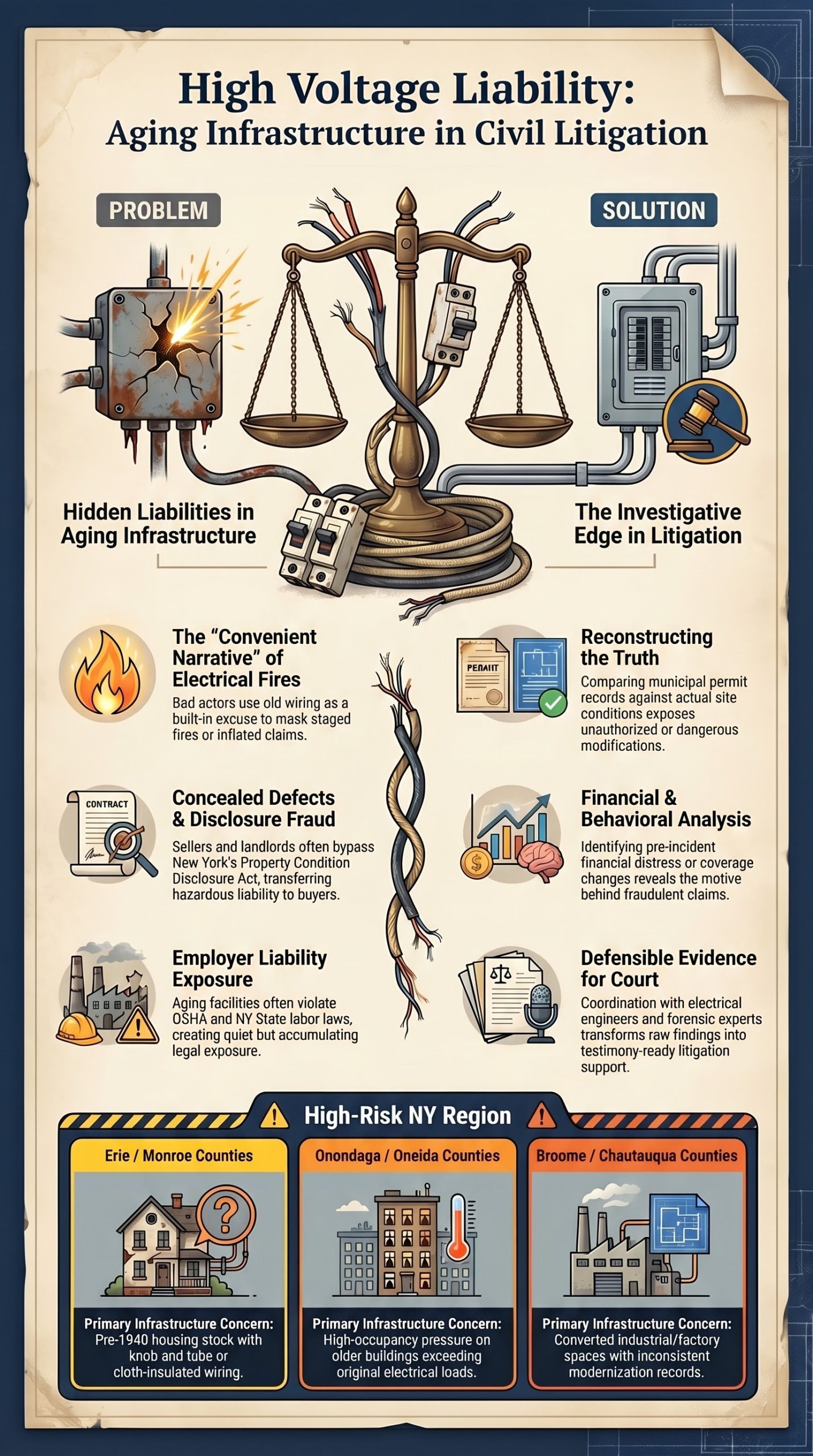
Across the region, aging electrical infrastructure sits at the center of a pattern that touches insurance carriers, property investors, landlords, municipalities, attorneys, compliance officers, and business owners. The problems tied to old wiring include fraudulent or inflated fire damage claims, concealed defects in property sales and lease agreements, workplace safety violations that go unreported until someone gets injured, hidden surveillance devices wired into outdated electrical systems, and regulatory noncompliance that creates quiet but accumulating liability.
For insurers writing policies across these counties, the exposure is real. For attorneys handling subrogation, premises liability, or real estate disputes, old electrical systems show up repeatedly in case files. And for businesses operating out of older buildings in places like Jamestown, Lockport, Elmira, and Watertown, the combination of outdated wiring and weak oversight creates conditions where fraud, negligence, and concealment can persist for years without detection.
The issue is not simply that old wiring exists. It is that old wiring creates an environment where the truth is harder to see, harder to verify, and easier to manipulate. That is exactly the kind of environment where an experienced investigative team adds the most value.
Chapter 2: The Counties and Communities Most Affected by Old Wiring
The concentration of aging electrical infrastructure in Western and Upstate New York is not evenly distributed. Certain counties and communities carry a disproportionate share of the risk because of when their buildings were constructed, how well those buildings have been maintained, and whether local code enforcement has kept up with modern standards.
Erie County
Buffalo is the center of gravity here. Entire neighborhoods on the East Side, West Side, and in South Buffalo are filled with homes built between 1890 and 1940. Many still have knob and tube wiring, cloth insulated circuits, or undersized panels that were never upgraded. The surrounding communities of Lackawanna, Cheektowaga, Tonawanda, and West Seneca share similar housing stock, particularly in the older residential corridors near former industrial sites. Hamburg and Kenmore also carry notable concentrations of pre-war homes with wiring that has been patched and extended over the decades rather than properly replaced.
Niagara County
Niagara Falls and Lockport both have dense pockets of aging residential and commercial properties. North Tonawanda, with its history as a lumber and manufacturing hub, has a significant inventory of older homes and converted commercial spaces where electrical systems have not been modernized. These are areas where property values are low enough that owners sometimes skip major upgrades, which allows outdated wiring to stay in service far longer than it should.
Monroe County
Rochester’s housing stock includes tens of thousands of homes built before 1950. Neighborhoods surrounding the old Kodak and Xerox corridors are densely packed with structures that were built during the city’s industrial peak. Irondequoit, Greece, and Brighton all contain older suburban homes where original electrical work has been supplemented with do-it-yourself additions rather than professional upgrades. The rental market in Rochester amplifies the risk because absentee landlords sometimes defer maintenance on systems they do not fully understand.
Onondaga County
Syracuse shares a similar pattern. The city’s north side, south side, and near west side neighborhoods contain thousands of aging residential structures. Solvay, Liverpool, and Camillus have their own pockets of older homes and small commercial buildings where wiring has not kept pace with demand. The university and hospital districts create high occupancy pressure on older buildings that may not have been wired to support modern electrical loads.
Additional Counties With Concentrated Risk
Chautauqua County: Jamestown, Dunkirk, and Fredonia all have older downtown cores with buildings dating to the late 1800s. Jamestown in particular has a legacy of converted factory and warehouse spaces where electrical modernization has been inconsistent.Cattaraugus County: Olean and Salamanca contain older residential and commercial buildings. Ellicottville’s seasonal tourism economy means some properties sit vacant for months, which masks deterioration in electrical systems.
Oneida County: Utica and Rome both carry heavy concentrations of pre-war housing. Utica’s refugee resettlement population has driven demand for affordable rentals in older buildings, increasing the stakes around wiring safety.
Broome County: Binghamton, Endicott, and Johnson City were all shaped by the rise and decline of major employers like IBM and Endicott Johnson. The housing stock reflects that era, and many of those homes have not received the electrical upgrades that modern living requires.
Chemung County: Elmira and Horseheads carry older building inventory. Flood damage history in parts of Elmira has led to rebuilds where electrical work was sometimes done without proper permitting.
Steuben County: Corning and Bath contain older homes and commercial buildings. The Corning area’s economic stability has kept many properties occupied, but maintenance on electrical systems still lags behind need.
Rensselaer County: Troy’s Victorian and industrial architecture is visually striking but carries the same wiring concerns as other cities built during that era.
Saratoga County: Saratoga Springs has a mix of historic properties and newer development. Older downtown buildings and converted estates sometimes contain wiring that has been modified repeatedly without consistent code compliance.
Genesee County: Batavia and Le Roy contain pockets of older residential and agricultural commercial buildings with outdated electrical systems.
Orleans County: Albion and Medina are smaller communities where code enforcement resources are limited, allowing aging wiring to persist with less oversight.
Wyoming County: Warsaw and Perry are rural communities where older farmsteads and village homes operate on systems that predate modern electrical standards.
Livingston County: Geneseo, Avon, and Dansville all have building stock that reflects the region’s agricultural and small manufacturing heritage.
Ontario County: Canandaigua and Geneva sit in the Finger Lakes corridor and contain a mix of historic homes and commercial properties where electrical modernization varies widely.
Seneca County: Seneca Falls and Waterloo are communities with deep historical roots and building stock that reflects their age.
Cayuga County: Auburn’s older neighborhoods and former manufacturing district carry the same pattern of aging infrastructure and deferred electrical maintenance.
Tompkins County: Ithaca’s rental market, driven heavily by Cornell University, puts intense pressure on older housing. Student rental properties in particular are frequently run on outdated electrical systems that have been repeatedly modified to accommodate modern demand.
Otsego County: Cooperstown and Oneonta both contain older homes and commercial buildings. The seasonal nature of Cooperstown’s tourism economy can mask maintenance gaps in commercial properties.
Herkimer County: Herkimer and Ilion carry legacy housing stock from the region’s manufacturing era.
Jefferson County: Watertown serves as the economic center near Fort Drum, and older parts of the city contain housing and commercial structures with outdated wiring that has been patched rather than replaced.
St. Lawrence County: Ogdensburg, Massena, Canton, and Potsdam all contain older building inventory. The remote nature of the North Country means that specialized electrical inspection and code enforcement resources can be limited.
Oswego County: Oswego and Fulton have older downtown cores with commercial and residential buildings that carry the full range of legacy wiring issues.
Schenectady County: Schenectady and Niskayuna, shaped by General Electric’s long presence, contain large volumes of older housing where electrical systems reflect the standards of a different era.
The pattern is consistent across the region: buildings that were designed for a fraction of today’s electrical demand, owned or managed by people who may not understand the condition of the wiring behind the walls, in communities where code enforcement is underfunded or overwhelmed.
Chapter 3: Insurance Fraud and Exaggerated Electrical Fire Claims
Electrical fires account for a significant share of residential and commercial property loss nationwide. In areas where aging wiring is widespread, such as Western and Upstate New York, the opportunity for fraudulent or inflated claims increases proportionally.
The fraud takes several forms. In some cases, a property owner deliberately causes an electrical fire to collect insurance proceeds on a building that has become a financial burden. In other cases, a fire that started from a non-electrical cause is attributed to faulty wiring to shift blame away from the policyholder or to increase the perceived legitimacy of the claim. And in a growing number of cases, the fire itself may be legitimate, but the claim filed afterward is inflated with exaggerated repair costs, fabricated contents losses, or misrepresented pre-loss conditions.
The investigative challenge lies in separating legitimate electrical failures from staged or misrepresented ones. A property in Niagara Falls with knob and tube wiring that genuinely overheats and ignites is a real risk. But a property in Utica where the owner was three months behind on mortgage payments and the fire conveniently started in a wall cavity near old wiring deserves closer examination.
Patterns that experienced investigators look for include: financial distress in the months before the fire, recent increases in insurance coverage, removal of personal items or valuables before the incident, prior claims history involving the same property or the same policyholder, inconsistencies between the fire origin determination and the physical evidence, and discrepancies between the claimed contents and the owner’s documented lifestyle.
For insurance carriers writing policies in Erie County, Monroe County, Onondaga County, and the smaller counties across the region, the combination of widespread aging wiring and economic pressure on property owners creates a persistent fraud exposure. The most effective defense is not better policy language alone. It is early, thorough investigation by professionals who know how to look past the surface story.
Chapter 4: Property Fraud: When Sellers and Landlords Conceal Dangerous Wiring
Real estate transactions in Western and Upstate New York frequently involve older properties. In many of these transactions, the condition of the electrical system is either poorly disclosed, actively misrepresented, or ignored by both sides until something goes wrong.
New York’s Property Condition Disclosure Act requires sellers to disclose known defects, including electrical issues. In practice, many sellers check “unknown” on disclosure forms or pay the $500 credit to avoid the form entirely. That legal workaround does not eliminate the risk. It simply transfers it to the buyer, who may not discover the true condition of the wiring until a fire, a failed inspection, or a renovation exposes what was hidden behind finished walls.
In the rental market, the problem compounds. Landlords in cities like Buffalo, Rochester, Syracuse, Binghamton, and Ithaca sometimes knowingly operate buildings with substandard electrical systems because the cost of upgrading exceeds what the rental income supports. When a tenant is injured or a fire occurs, the landlord may claim ignorance of the condition, but a thorough investigation can often reveal that the landlord had prior notice through inspection reports, tenant complaints, contractor estimates, or insurance communications.
Investigative Red Flags in Property Transactions:Sellers or landlords who have received prior electrical inspection results but did not disclose them. Properties that were recently insured at values that do not match the condition of the building. Renovation permits that were pulled for other work but did not include electrical upgrades. Properties where the electrical panel has been modified without permits. Buildings where aluminum wiring, Federal Pacific panels, or other known hazard indicators are present but were not mentioned in transaction documents.
Attorneys handling real estate disputes, premises liability cases, and landlord/tenant litigation in these counties need investigators who can reconstruct the timeline of what the seller or landlord knew, when they knew it, and what they chose to do or not do with that information.
Chapter 5: Hidden Cameras, Surveillance Devices, and Older Electrical Systems
Buildings with aging electrical infrastructure present a distinct challenge when it comes to detecting unauthorized surveillance devices, hidden cameras, and covert recording equipment. The reason is straightforward: older wiring creates more electromagnetic noise, more unusual signals, and more structural access points that can mask the presence of hidden devices.
Modern Technical Surveillance Countermeasures (TSCM) sweeps rely on detecting radio frequency emissions, unusual power draws, and anomalous wiring configurations. In a newer building with clean, well documented electrical systems, a hidden device stands out more clearly against the baseline. In an older building in Jamestown, Troy, Auburn, or Watertown, the baseline itself is chaotic. Junction boxes with abandoned wires, ungrounded circuits, inconsistent voltage levels, and decades of undocumented modifications all create interference that a hidden camera or listening device can hide behind.
Where This Risk Applies:Corporate offices operating in converted historic buildings. Hotels and short-term rentals housed in older properties. Law offices and medical practices in older commercial spaces. Residential properties where domestic disputes, custody battles, or stalking concerns are present. Multi-tenant commercial buildings where different occupants share electrical infrastructure without clear documentation.
For individuals, families, businesses, and legal professionals who suspect unauthorized surveillance in an older building, the investigation requires a team that understands both the electronic detection methods and the physical realities of aging electrical systems. A sweep team that only knows modern construction will miss signals that disappear into the background noise of old wiring.
Insight Investigations provides hidden camera detection and TSCM support across New York State, including in the older commercial and residential buildings that are common throughout Western and Upstate New York.
Chapter 6: Workplace Safety, Compliance, and Employer Liability in Aging Facilities
Employers who operate out of older buildings in Western and Upstate New York are obligated under OSHA regulations and New York State labor law to maintain safe working conditions, including the electrical systems in their facilities.
The problem is that many employers either do not know the true condition of their electrical systems or choose not to address it because the cost of remediation is high and the risk feels abstract until something happens. In cities like Buffalo, Rochester, Syracuse, Utica, Binghamton, Elmira, and Corning, manufacturers, warehouses, retail operations, restaurants, and service businesses regularly occupy buildings that are 60 to 120 years old. The wiring in those buildings may not support the equipment load, may not meet current code, and may not have been inspected in years.
When an employee is injured by an electrical fault, when a fire shuts down operations, or when an OSHA inspection reveals violations, the employer’s awareness and response history becomes the central issue. Did the employer know about the electrical deficiencies? Were there prior incidents, complaints, or inspection findings? Did the employer take corrective action, or did they ignore the problem?
For attorneys representing injured workers, for compliance officers conducting internal reviews, and for insurance carriers evaluating employer liability, the investigative question is the same: what did the employer know, and what can be documented? Investigators who specialize in workplace and regulatory compliance matters can reconstruct that record, identify gaps in the employer’s maintenance and inspection history, interview witnesses, review permits and contracts, and produce findings that support litigation, regulatory response, or internal corrective action.
Insight Investigations works with employers, insurers, and counsel across New York State on workplace safety, regulatory compliance, and employer liability matters. Our team includes former federal investigators and attorneys who understand both the operational and legal dimensions of these cases. Contact Insight Investigations →
Chapter 7: How Investigators Uncover the Truth Behind Electrical Incidents
A fire happens. A claim gets filed. A tenant gets hurt. A sale closes on a building that turns out to have dangerous wiring. In each of these situations, the question is not just what happened, but what can be proven.
The investigative process for matters involving aging electrical systems in Western and Upstate New York typically involves several coordinated methods.
Scene and Property Assessment
Investigators examine the physical property, photograph existing conditions, document wiring type and condition, identify panel configurations, note signs of unpermitted work, and establish a baseline understanding of the electrical system. In older buildings across the region, this step often reveals conditions that were not disclosed in transaction records, insurance applications, or employer safety files.
Records and Permit Research
Municipal building departments in cities like Buffalo, Rochester, Syracuse, Niagara Falls, Utica, and Binghamton maintain permit records that show what electrical work was authorized and when. Investigators compare those records against the actual condition of the property to identify unauthorized modifications, skipped inspections, and gaps in the documented history. County and town offices in the surrounding areas, including Batavia, Canandaigua, Geneva, Auburn, Ithaca, and Saratoga Springs, carry similar records that can be reviewed.
Financial and Ownership Analysis
For insurance fraud matters, investigators examine the financial condition of the property owner, the insurance coverage history, the timing of policy changes, and any connections between the owner and contractors, adjusters, or other parties involved in the claim. This analysis often reveals patterns of behavior that would not be visible from the claim file alone.
Digital Footprint and Open Source Research
Social media activity, online reviews, property listings, public records, and digital communications can all provide evidence that contradicts or supports the narrative being presented. An owner who claims total loss on a building but was advertising it for sale weeks earlier as “fully updated” creates a documented contradiction. A landlord who responds to a tenant’s online complaint about flickering lights with a promise to fix the wiring creates a record of notice.
Surveillance and Field Operations
In cases involving suspected fraud, ongoing concealment, or contested facts, field surveillance can document activity that directly contradicts the subject’s statements. A claimant who reports total displacement after a fire but is seen entering the property regularly, or a landlord who claims to have hired a licensed electrician but is observed doing the work personally, creates evidence that shifts the entire posture of the case.
Witness Identification and Interviews
Neighbors, former tenants, contractors, inspectors, and municipal employees often hold information that is not in any file. Investigators locate and interview these individuals to build a more complete picture of what happened, what was known, and who was responsible.
Expert Coordination and Litigation Support
When the matter is heading toward litigation, investigators coordinate with electrical engineers, fire investigators, code enforcement professionals, and forensic accountants to produce work product that meets courtroom standards. At Insight Investigations, our team includes professionals who have testified in state and federal proceedings and who understand the evidentiary requirements that New York courts demand.
Chapter 8: What Property Owners, Insurers, and Attorneys Should Do Next
The risks created by aging electrical systems in Western and Upstate New York are not going away. The housing stock is not getting younger. The commercial buildings are not upgrading themselves. And the economic pressures that lead to deferred maintenance, concealed defects, and fraudulent claims are not easing.
What can change is how the people affected by these risks respond to them.
For Insurance Carriers and SIU Teams
Every electrical fire claim in the region deserves a second look. That does not mean every claim is fraudulent. It means that the prevalence of old wiring creates a narrative convenience that bad actors rely on. Early engagement of investigators, particularly on claims with financial stress indicators, coverage changes, or inconsistent origin determinations, can identify fraud before settlement and protect payout integrity.
For Attorneys
Whether you represent plaintiffs or defendants in property disputes, premises liability, subrogation, landlord/tenant litigation, or regulatory enforcement, the facts behind old electrical systems often determine the outcome. Early investigative support helps you pressure test the claims, verify the timeline, and build the evidentiary foundation before the other side has a chance to shape the story.
For Property Owners and Business Operators
If you own or operate out of an older building in Western or Upstate New York, knowing the true condition of your electrical system is not optional. It is the foundation of your liability posture. If you are acquiring property, conducting due diligence that includes the electrical system protects you from inheriting someone else’s concealed risk.
For Compliance Officers
Regulatory exposure tied to electrical safety violations in older facilities is a growing area of enforcement activity. Proactive review, supported by investigative professionals who can document conditions and reconstruct compliance timelines, positions your organization to address problems before they become public, expensive, or both.
Insight Investigations is a New York State licensed private investigation firm staffed by former FBI professionals, attorneys, and national security experts. We work with law firms, corporations, insurance carriers, and compliance professionals across Western New York, Upstate New York, and the entire state on matters involving fraud, misconduct, property risk, surveillance, due diligence, hidden device detection, and litigation support.If you are facing a situation where old electrical infrastructure is part of the risk picture, we can help you separate fact from fiction, document what matters, and deliver findings that hold up when it counts.Request a Confidential Consultation →📞 Call us directly or use our secure contact form. All inquiries are handled with strict confidentiality.
Summary
Aging electrical systems across Western and Upstate New York are more than a building maintenance issue. They sit at the intersection of insurance fraud, property misrepresentation, workplace liability, surveillance risk, and regulatory compliance exposure. Communities from Buffalo and Rochester to Syracuse, Utica, Binghamton, Jamestown, and the smaller towns throughout the region all carry significant concentrations of pre-war and mid-century buildings where wiring has not kept pace with modern safety standards or modern electrical demand.For insurers, old wiring provides a convenient and often accepted explanation that can mask fraudulent fire claims. For buyers and tenants, concealed electrical defects create injury risk and financial exposure that surface only after the transaction closes. For employers, aging facilities carry OSHA and state labor law liability that accumulates quietly until an incident forces attention. For individuals and businesses concerned about unauthorized surveillance, older buildings create detection challenges that require specialized expertise.
Insight Investigations provides the investigative, analytical, and litigation support capabilities needed to address each of these risk areas. Our team, built from former FBI professionals, licensed attorneys, and national security specialists, operates across New York State with a focus on producing clear, defensible findings for the clients who need them most.
References
Ahrens, M. (2021). Home electrical fires. National Fire Protection Association. https://www.nfpa.org/education-and-research/research/nfpa-research/fire-statistical-reports/home-electrical-fires
Campbell, R. (2022). Electrical fires in nonresidential structures. National Fire Protection Association. https://www.nfpa.org/education-and-research
Insurance Information Institute. (2023). Facts + statistics: Fire. https://www.iii.org/fact-statistic/facts-statistics-fire
National Electrical Manufacturers Association. (2020). Field evaluation of electrical products: A guide to best practices. NEMA.
National Fire Protection Association. (2023). NFPA 70: National Electrical Code. NFPA.
New York State Department of State, Division of Licensing Services. (2023). Private investigator licensing requirements. https://dos.ny.gov
New York State Real Property Law § 462: Property Condition Disclosure Act. N.Y. Real Prop. Law § 462 (McKinney).
Occupational Safety and Health Administration. (2023). Electrical safety standards (29 CFR 1910 Subpart S). United States Department of Labor. https://www.osha.gov/electrical
Swerling, J. (2019). The age of housing stock and its implications for fire risk. Journal of Fire Protection Engineering, 29(3), 145–162.
U.S. Census Bureau. (2020). American Community Survey: Year structure built. https://data.census.gov
U.S. Consumer Product Safety Commission. (2021). 2020 annual report: Electrocutions associated with consumer products. CPSC.
U.S. Fire Administration. (2022). Residential building electrical fires (2019–2021). Federal Emergency Management Agency. https://www.usfa.fema.gov
Insight Investigations is a New York State licensed private investigation firm. Our team includes former FBI professionals, attorneys, and national security experts. We serve law firms, corporations, insurance carriers, and compliance professionals across New York State.Services include: Corporate Fraud & Financial Investigations · Litigation Support & Law Firm Referrals · Due Diligence & Background Investigations · Insurance Fraud Investigations · Surveillance & Field Operations · Digital & Online Investigations · Intellectual Property & Trade Secret Cases · Workplace & Employment Investigations · Expert Reports & Litigation Testimony Support · Insider Threat Investigations · Hidden Camera & Sensors · Regulatory & Compliance Investigations · Infidelity Investigations · Digital Footprint Analysis · Lifestyle Verification · Behavioral Pattern Analysis