

BLUF
People lie with confidence. Their digital footprint often does not. In high-stakes disputes, fraud matters, workplace claims, insurance cases, and pre-suit investigations, social media and online activity can expose contradictions that change the entire case. What someone says in a statement, complaint, interview, or claim file may fall apart when compared against what they posted, shared, followed, reviewed, tagged, joined, or publicly connected online.
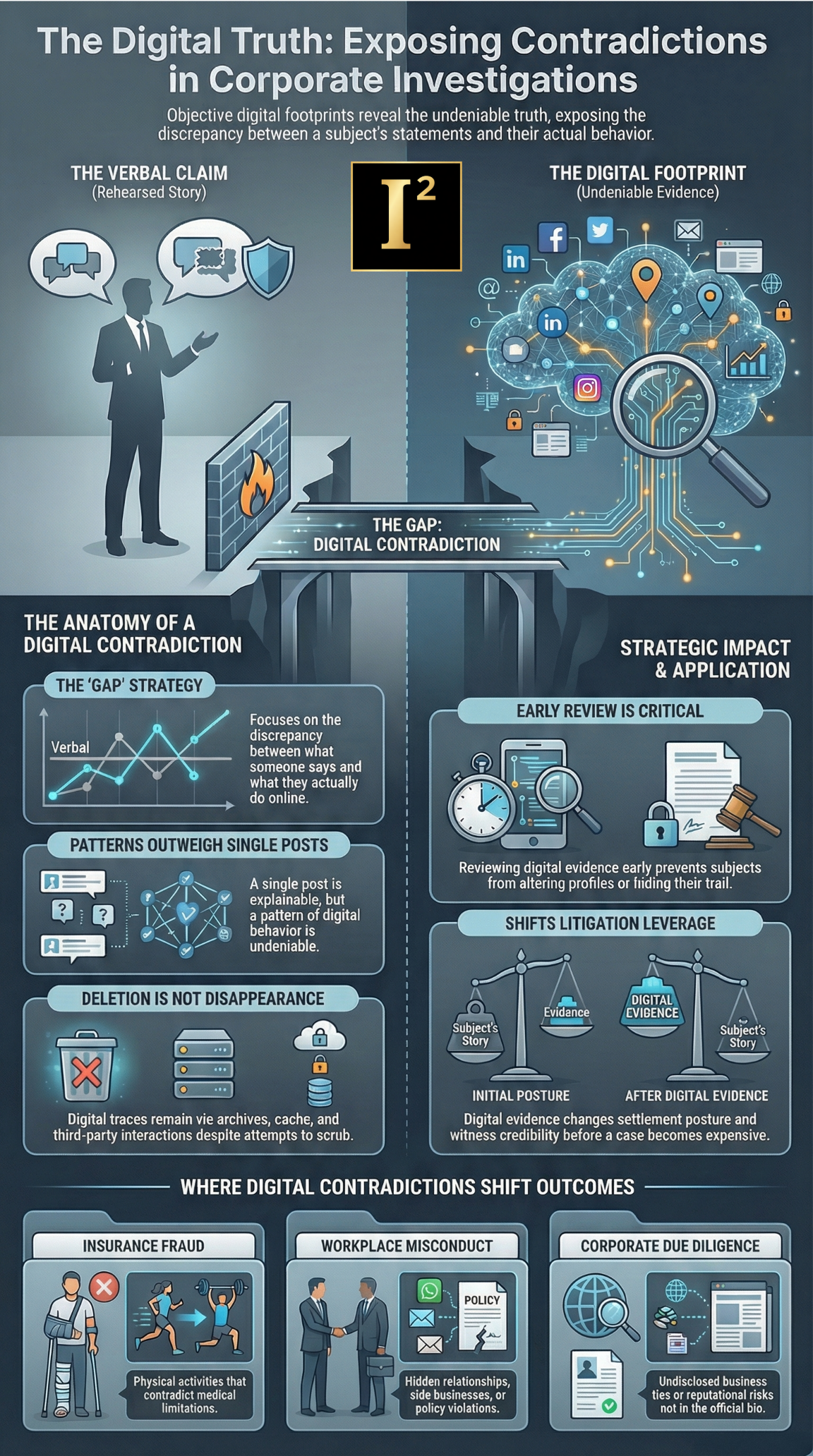
The internet keeps receipts
A lot of people still think of social media as casual.
It is not.
It is evidence.
Not always perfect evidence. Not always complete. But often enough, it is the piece that turns suspicion into clarity.
A person says they were not there.
Their tagged photo says otherwise.
A claimant says they are physically limited.
Their public posts show a very different picture.
An employee denies contact with a competitor.
Their online connections, comments, and digital trail suggest an ongoing relationship.
A business partner claims ignorance.
Their activity shows they knew far more than they admitted.
This is why digital investigations matter.
People can rehearse a story.
They are usually much worse at managing the trail they leave behind.
Why online contradictions matter so much
Contradictions do more than embarrass someone. They damage credibility.
And credibility is often the center of the fight.
When a person makes a claim, denies involvement, downplays a relationship, or presents a timeline, they are asking the decision maker to trust their version of events. Once the digital record starts pointing in another direction, the whole matter changes.
That can affect:
Litigation strategy
Settlement posture
Witness credibility
Employment decisions
Insurance claim review
Fraud investigations
Internal disciplinary action
Pre filing leverage
Reputational exposure
One contradiction may be explainable.
A pattern of contradictions is much harder to dismiss.
Social media is not just Facebook posts
This is where many people think too narrowly.
Digital investigations are not limited to scrolling through a profile and hoping for a careless photo. Strong digital work looks wider and deeper.
Relevant digital evidence may come from:
Social media profiles
Public posts and comments
Tagged photos and videos
Event participation
Location patterns
Professional networking activity
Business review platforms
Marketplace listings
Public usernames across platforms
Archived web content
Forum activity
Connections between accounts
Changes in profile behavior over time
Publicly visible group affiliations
Digital timing that supports or undermines a timeline
In other words, the contradiction is not always in one dramatic post. Sometimes it is in the pattern.
The lie is often in the gap between words and behavior
This is what good digital investigations focus on.
Not just what someone said.
Not just what they posted.
But the gap between the two.
That gap tells you where to look next.
A person claims they are no longer involved with a company, yet they continue promoting it online, interacting with insiders, and appearing in related digital spaces.
An employee denies a personal relationship that may create a conflict of interest, but the online trail shows repeated interactions, shared social circles, overlapping travel, and coordinated presence.
A fraud subject says a transaction was routine, but the timing of online conduct, contacts, and public statements suggests planning, awareness, or motive.
A witness says they barely know someone, yet the digital record shows years of visible connection.
This is how cases shift.
Not because social media is magic.
Because people reveal themselves over time.
Why digital investigations work when interviews do not
In many matters, the interview comes after the person has already had time to prepare.
They know what is at stake.
They know what they want to deny.
They know what version sounds safest.
But digital conduct often happened before the pressure started.
That matters.
Posts made casually, interactions that looked harmless at the time, public behavior no one expected to be reviewed, and small online signals spread across platforms can become powerful once viewed in context.
A person may lie well in a room.
Their digital history may still tell the truth.
Common cases where digital contradictions matter
Pre-suit investigations
Before a complaint is filed, counsel needs to know whether the facts hold up. Digital contradictions can expose weaknesses in a client’s story, identify leverage, or reveal risks that would become expensive after filing.
Insurance fraud matters
Claimants may present one version of physical condition, routine, or activity while their public digital behavior suggests something very different. Even when the contradiction is not dispositive by itself, it may justify deeper investigation.
Workplace investigations
Harassment, retaliation, conflict of interest, dishonesty, outside business activity, and policy violations often leave a digital trail. Public comments, affiliations, and interactions can support or undermine internal claims.
Corporate fraud and insider threat cases
Digital behavior can reveal hidden relationships, side business interests, undisclosed connections, suspicious timing, or links between individuals whose involvement was denied.
Infidelity and lifestyle verification matters
Public posts, follows, tags, location patterns, and repeated online interaction can expose undisclosed relationships and contradictory personal narratives.
Due diligence investigations
A polished executive or company profile may look clean until digital history reveals reputational issues, associations, old statements, business ties, or conduct patterns that were never disclosed.
What people get wrong about deleting content
A lot of people think they can clean things up after the fact.
Sometimes they try.
They delete posts.
Lock accounts.
Remove photos.
Change usernames.
Unfollow people.
Scrub public bios.
That does not always solve the problem.
First, deletion itself can be telling. A sudden attempt to erase visible connections or online behavior may support the idea that the person knows the content is damaging.
Second, digital investigations are not always about what is visible today. Public traces can remain through cached content, archived material, connected accounts, interaction history, screenshots, timestamps, and third party platforms.
Third, behavior patterns often survive even when individual posts disappear.
The story usually leaves more than one mark.
Why timing matters
Digital evidence is strongest when it is reviewed early.
That is because online content changes fast. Accounts get altered. Privacy settings shift. Posts disappear. Profiles get renamed. Connections get hidden. The trail gets colder.
Delay gives the subject time to adjust.
Early review helps preserve context, identify relevant content, map relationships, and direct the broader investigation before the subject understands where the pressure may come from.
In many matters, that timing difference is huge.
What a real digital investigation should do
A serious digital investigation is not random searching.
It should answer specific questions.
Does the public record match the claimed timeline
Are there online ties between people who deny a relationship
Has the subject publicly displayed conduct inconsistent with the claim
Are there indicators of motive, coordination, or prior awareness
Do public statements conflict with private allegations
Are there patterns across platforms that reveal something the person did not disclose
The goal is not noise.
The goal is usable facts.
Digital contradictions can strengthen your case or stop a bad one
This matters on both sides.
Sometimes digital evidence strengthens a strong case by confirming what the client suspected.
Sometimes it stops a weak case before money gets wasted.
That is just as important.
A good investigator is not there to force a theory. The job is to test it.
If the digital record supports the claim, that matters.
If it undermines the claim, that matters too.
Truth is still useful even when it is inconvenient.
Why attorneys and decision makers should care
Digital contradictions do not sit in a vacuum. They shape what comes next.
For attorneys, they affect pleading strategy, witness prep, settlement leverage, and discovery decisions.
For employers, they affect credibility findings, internal action, and exposure management.
For insurers, they affect claim evaluation and litigation posture.
For executives and business owners, they affect whether a concern is real, exaggerated, or pointing to a larger hidden problem.
The point is simple.
Ignoring the digital trail is no longer a serious option.
What makes digital investigations effective
Effective digital investigations are disciplined.
They are focused on relevance.
They preserve context.
They separate noise from signal.
They do not overclaim.
They connect digital facts to the actual issue in dispute.
That is what turns online activity into evidence that matters.
Not screenshots without context.
Not gossip from the internet.
Not assumptions.
Facts. Patterns. Contradictions. Documentation.
Bottom line
Social media never forgets, even when people try to.
In high stakes investigations, the digital trail often says what the subject will not. It exposes contradictions in timelines, relationships, physical activity, business ties, intent, and credibility. That does not mean every post is proof. It means public digital behavior can reveal facts that change the direction of a case before a complaint is filed, before a claim is paid, before an employer makes the wrong call, or before a bad story hardens into an expensive legal fight.
The people who win these cases are not the ones who assume. They are the ones who verify.
And in 2026, verification includes the digital trail.
Before you trust the statement, review the digital trail. Insight Investigations helps attorneys, insurers, employers, and decision makers uncover online contradictions, hidden connections, and public digital evidence that can change the direction of a case before the wrong move is made.