

BLUF
The biggest fraud threat in your company probably is not sitting in the CFO’s office, and it rarely shows up like a movie version of fraud. More often, it hides inside routine approvals, trusted employees, vendor relationships, weak oversight, and small exceptions that get ignored until the damage is already serious. Internal fraud usually survives because it looks normal on the surface, blends into daily operations, and is protected by trust, habit, and the belief that no one would ever take a closer look.
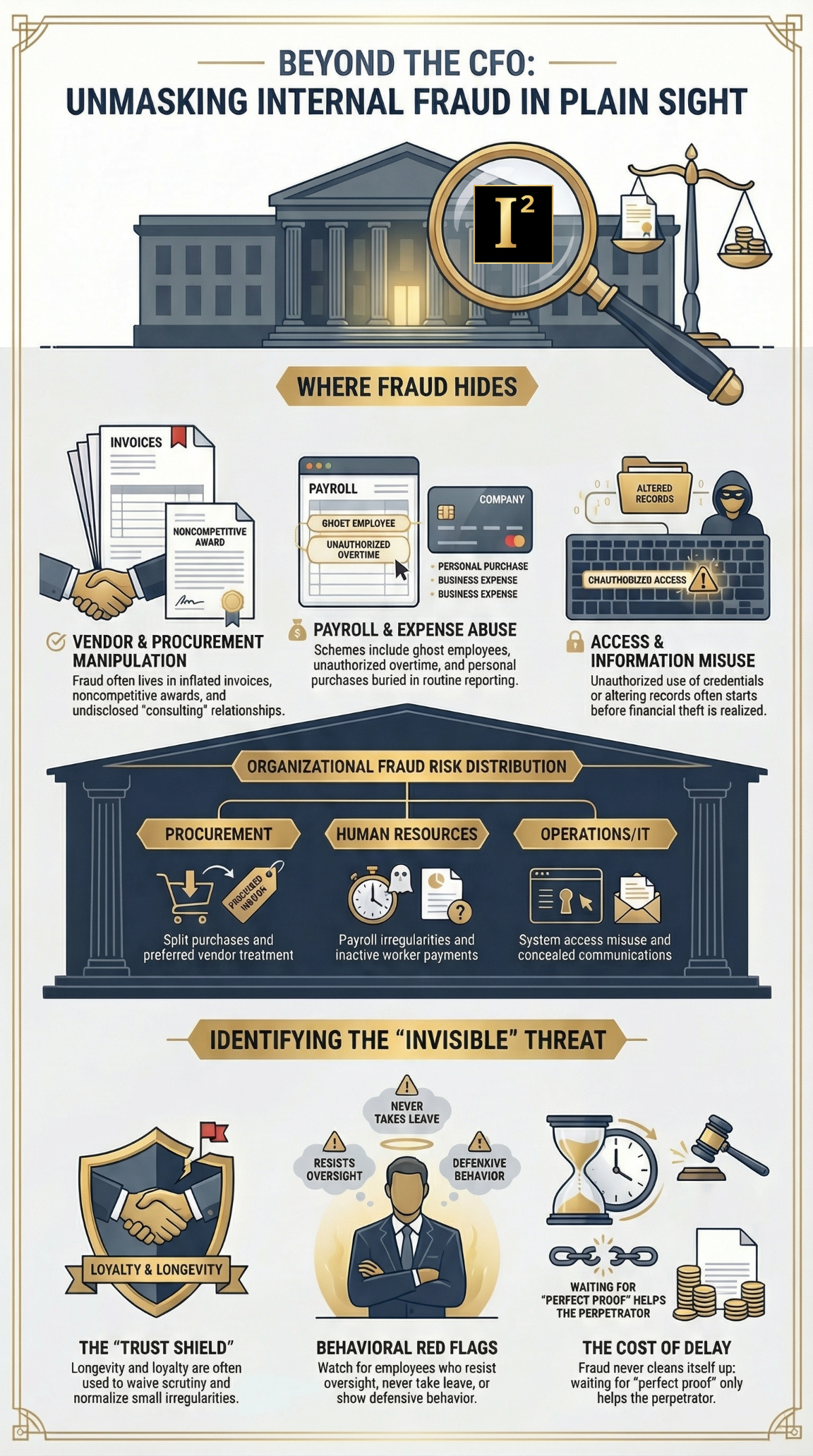
Internal fraud rarely looks like fraud at first
When companies think about fraud risk, they usually picture the obvious threat.
A senior executive moving money.
A finance leader cooking the books.
A controller hiding losses.
A payroll manager is stealing funds.
That happens. But it is not the whole picture.
A lot of internal fraud lives much lower in the organization. It hides within ordinary workflows, familiar relationships, and small process gaps that people stopped questioning long ago.
That is why companies miss it.
The risk is not only at the top. The risk is often in the middle, around the edges, and buried inside day-to-day operations where no one expects to find it.
The most dangerous fraud is the kind that looks normal
Fraud gets expensive when it blends into routine.
An employee submits the same type of reimbursement every month.
A vendor invoice gets approved because that vendor has always been used.
A purchasing manager keeps steering work to the same outside company.
A team member has access; nobody ever reevaluated.
A supervisor overrides controls because it is faster.
A trusted employee handles too many steps in the same process.
None of that sounds dramatic.
That is exactly the problem.
Internal fraud often survives because it wears the costume of normal business activity.
Why companies overlook internal fraud
Most organizations do not deliberately ignore fraud. They miss it because the signals are easy to explain away.
Trust replaces verification
The longer someone has been around, the less scrutiny they tend to get.
People say things like:
He would never do that
She has been here for years
They are loyal
That person knows the system better than anyone
Sometimes that is true.
Sometimes that is the shield.
Small irregularities get normalized
One odd invoice does not feel like a crisis.
One missing receipt gets waved through.
One conflict of interest gets explained away.
One access exception becomes permanent.
Fraud grows in environments where small control failures are treated as harmless.
Leadership looks for clean theft, not messy patterns
Executives often expect fraud to show up as a clean event.
Missing money.
Fake signatures.
A direct transfer.
A clear confession.
Real internal fraud is often messier.
It may involve inflated billing, quiet self-dealing, side agreements, manipulated approvals, misuse of resources, hidden relationships, or selective reporting that slowly distorts the financial picture.
Nobody wants to accuse the wrong person
This is one of the biggest reasons fraud lingers.
Leaders hesitate because accusations carry risk. HR hesitates because of exposure. Legal hesitates without enough proof. Managers hesitate because the employee is useful. Finance hesitates because the process failure may point back at them.
So the issue sits.
And while it sits, it grows.
Fraud is not limited to finance
This is where many companies get blindsided.
The CFO is not the only risk. The accounting department is not the only place fraud lives.
Internal fraud can sit inside:
Procurement
Operations
Sales
Human resources
Facilities
IT
Payroll
Project management
Executive administration
Vendor management
Compliance functions
Anywhere there is trust, access, money, discretion, or a broken review process, there is risk.
Common places internal fraud hides in plain sight
Vendor relationships
A lot of fraud lives in the space between an employee and an outside vendor.
Inflated invoices.
Duplicate billing.
Preferred treatment with no real competition.
Related party vendors nobody disclosed.
Kickbacks hidden behind “consulting” relationships.
Work approved but never completed.
On paper, it looks like normal business.
Under scrutiny, it may be something very different.
Expense abuse and reimbursement manipulation
This gets dismissed far too often as minor misconduct.
It is not always minor.
Repeated inflated travel costs, duplicate submissions, fabricated business meals, personal purchases buried in routine expense reporting, and manipulated approvals can reveal a broader honesty problem.
Sometimes the dollar value is not the main issue.
The bigger issue is what the conduct says about access, intent, and the belief that nobody is watching.
Payroll and ghost employee schemes
This can happen in surprisingly unsophisticated ways.
Unauthorized hours.
Improper overtime.
Inactive workers still being paid.
Shared control over payroll setup and approval.
Temporary staff arrangements nobody fully verifies.
These issues can sit for a long time when payroll trust is high and review is weak.
Procurement and purchasing irregularities
Procurement fraud often hides behind volume, urgency, and technical complexity.
Split purchases to avoid approval thresholds.
Noncompetitive awards dressed up as necessity.
Personal relationships driving purchasing decisions.
Inventory discrepancies.
Product substitutions.
Recurring orders that do not match operational need.
Many of these schemes survive because reviewing them takes time, and most teams are already stretched.
Access misuse and insider manipulation
Not all internal fraud is purely financial.
Sometimes the misconduct involves access to systems, files, client data, trade information, or sensitive internal knowledge.
Employees or contractors may misuse credentials, extract data, alter records, conceal communications, or move information in ways that create financial, legal, and reputational exposure.
That kind of misconduct often starts before anyone realizes a fraud issue exists.
The red flags companies should stop ignoring
Internal fraud usually leaves a trail. The problem is that the trail often gets explained away instead of examined.
Watch for patterns like:
Employees who resist oversight
People who will not take leave
Repeated approval exceptions
Unusual loyalty to a specific vendor
Unclear documentation
Lifestyle changes that do not match compensation
Defensive behavior around routine questions
Missing records
Late changes to reports or entries
One person controlling too many parts of a process
Frequent off the books workarounds
Unusual access patterns
Meetings or communications that avoid normal channels
A single red flag may mean nothing.
A cluster of them usually means something deserves a closer look.
Why internal fraud investigations matter before the damage spreads
By the time a fraud issue becomes obvious, the harm is often much larger than leadership expected.
The losses may include:
Direct financial loss
Legal exposure
Insurance complications
Regulatory scrutiny
Employee morale damage
Reputational harm
Destroyed vendor trust
Litigation costs
Data compromise
Leadership credibility problems
A good investigation does more than confirm wrongdoing. It helps establish scope.
What happened.
Who was involved.
How long it lasted.
What systems failed.
What evidence exists.
What decision makers need to do next.
Without that clarity, companies tend to react emotionally, inconsistently, or too late.
Why these cases require discretion
Internal fraud allegations can damage innocent people if handled poorly.
That is why disciplined investigative work matters.
A serious investigation is not a rumor hunt. It is not office politics with a nicer label. It is not about “seeing what turns up.”
It is about objective fact development.
That means reviewing records, testing assumptions, mapping relationships, validating timelines, examining conduct, and preserving evidence in a way that supports real decisions.
Handled correctly, an investigation protects both the organization and the integrity of the process.
What a professional internal fraud investigation can uncover
A strong investigation can help uncover:
Undisclosed vendor relationships
Patterns of false billing
Expense abuse
Procurement manipulation
Internal collusion
Conflict of interest issues
Payroll irregularities
Document alteration
Unauthorized access or misuse of systems
Concealed communications
Hidden financial motives
Policy failures that made the misconduct possible
Just as important, it can also help confirm when suspicious activity is not fraud and point leadership toward the real cause.
That matters too.
The cost of waiting
The instinct to “watch it a little longer” can be costly.
Fraud rarely gets cleaner with time.
Evidence rarely gets easier to find.
Stories rarely stay loose once people sense scrutiny.
Losses rarely stop on their own.
Delay helps the wrong person.
When something feels off, leadership does not need panic. It needs facts.
Bottom line
Internal fraud is not always sitting in the CFO chair.
Sometimes it is buried inside purchasing.
Sometimes it is sitting in payroll.
Sometimes it is hiding inside vendor relationships, access misuse, or years of unchecked exceptions.
The biggest threat is often not bold theft. It is quiet misconduct that blends into normal operations until the numbers, the records, or the damage finally force attention.
By then, the problem is harder to contain.
Companies that take internal risk seriously do not wait for perfect proof. They investigate patterns, verify facts, and act before routine misconduct turns into a legal and financial disaster.
That is how fraud gets exposed.
That is how damage gets contained.
That is how trust gets rebuilt.
Do not wait for a financial disaster to confirm what your instincts already suspect. If something feels off inside your company, Insight Investigations can help you uncover the facts, identify the risk, and document what is really happening before the damage spreads.