

BLUF
For corporations and litigation counsel in New York State, a properly licensed private investigator can be a high-leverage extension of your litigation team, locating witnesses and assets, validating or discrediting claims, documenting fraud, supporting service of process, and preserving evidence before it disappears. New York’s licensing statute defines “private investigator” broadly to include investigations into identity, conduct, whereabouts, employee activity, and “securing of evidence” for trial, meaning many common litigation support tasks fall inside the regulated lane.
The upside is asymmetric: early, lawful fact development can change settlement posture, motion strategy, injunctive relief timing, and collectability. The downside is also asymmetric: a single out-of-bounds act (unlawful recording, unauthorized access to emails, improper use of consumer reports, prohibited “pretexting,” or mishandled digital evidence) can expose a party to criminal liability, civil liability, evidentiary sanctions, and reputational harm.
Operationally, the safest and most effective posture is counsel-led: a written scope tied to claims/defenses; a compliance boundary memo; defensible collection methods; chain-of-custody discipline; and deliverables designed for admissibility (authentication, metadata, and testimony-ready documentation). Federal and New York law both recognize litigation representatives (including agents) in the work-product framework, but sloppy engagement structure and uncontrolled distribution can still waive protections or invite motion practice.
Assumptions (explicit): This report addresses civil litigation needs (state and federal courts sitting in New York), not criminal defense investigation strategy; it assumes the investigator is retained either by counsel or by a corporate client acting under counsel’s direction; and it assumes no budget constraint. Where local NYC-specific process server rules are discussed, that is because NYC is a dominant venue for NY civil practice and has distinct statutory and regulatory requirements for process servers beyond statewide CPLR service rules.
Contents (detailed):
- Asymmetric priority map: when an investigator changes outcomes
- New York legal framework: licensing, what’s permitted, what’s prohibited
- Federal law overlay: privacy, wiretapping, consumer reports, computer access, medical data
- Core civil litigation use cases: services, deliverables, and legal/risk matrix
- Procedure and evidentiary considerations: chain of custody, admissibility, spoliation
- Ethical and privilege issues for counsel: supervision, no-contact, truthfulness, social media
- Compliance risks and best practices: vendor selection, workflow, and ROI
- Sector-specific examples: finance, healthcare, construction, tech, real estate, nonprofits, private equity, hospitality, retail, manufacturing
Asymmetric analysis and high-impact reasons
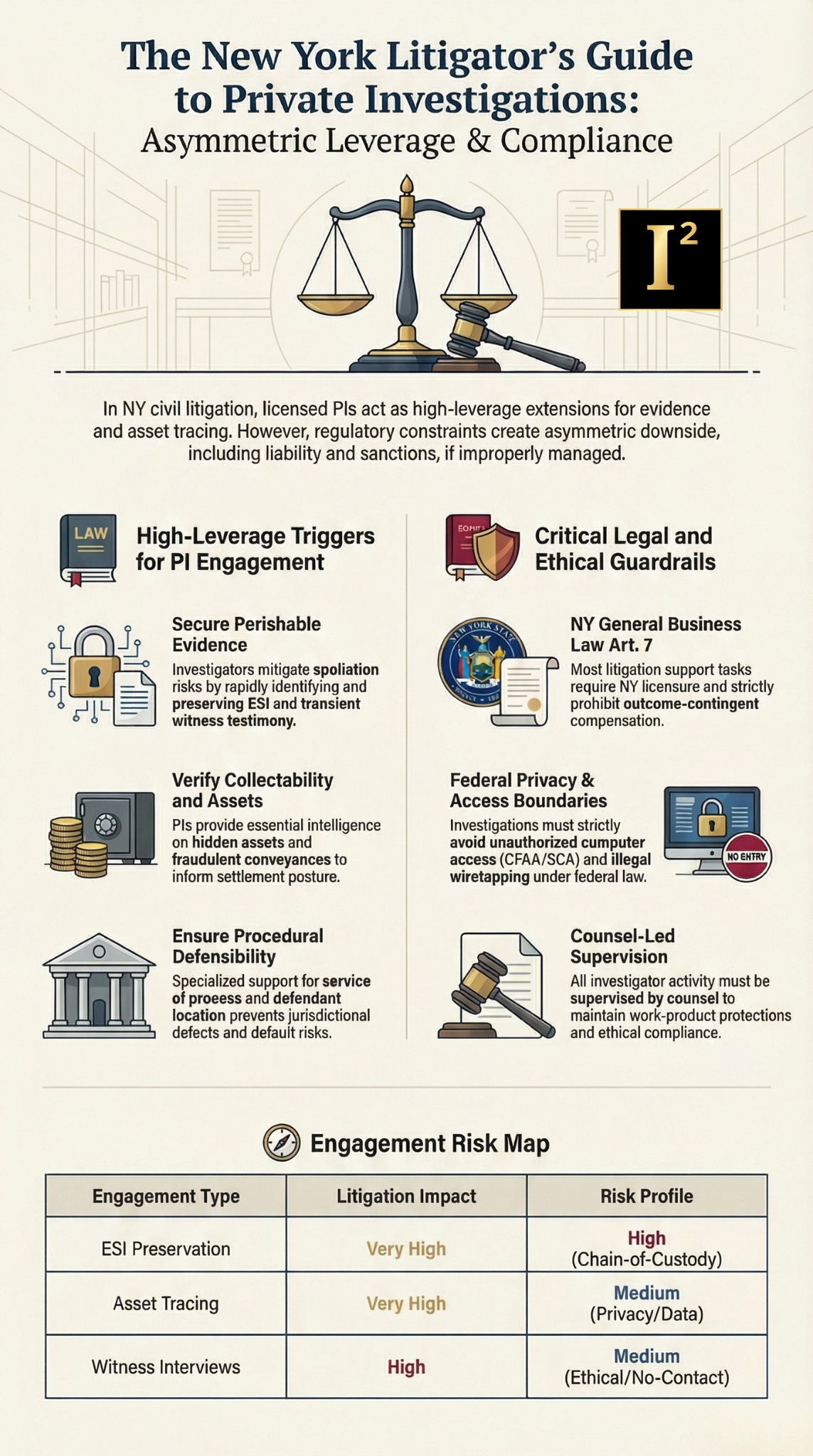
“Asymmetric analysis” here means: small investigative moves that create outsized litigation impact, especially when time sensitivity, evidentiary fragility, or collectability constraints exist.
High-leverage triggers
A private investigator is most outcome-changing when one or more of these are true:
- Evidence is perishable (ESI deletion cycles, mobile device churn, transient witnesses, surveillance opportunities). New York courts apply spoliation standards that turn heavily on notice, preservation efforts, and culpability, and federal spoliation sanctions for lost ESI are governed by Rule 37(e).
- Collectability is uncertain (judgment enforcement, fraudulent conveyances, alter ego, hidden assets).
- Credibility is central (disability claims, harassment claims with conflicting narratives, trade secret misappropriation with competing access stories). “Credibility of witnesses” and securing evidence for trial are explicitly within the NY statutory definition of “private investigator.”
- A threshold procedural win matters (proper service, locating defendants, validating domicile/residence, identifying corporate agents).
- Your opponent can weaponize compliance errors (such as illegally obtained evidence, improper recordings, or unauthorized access). New York Penal Law criminalizes unauthorized computer access and eavesdropping-related conduct; federal statutes add parallel exposure (SCA/CFAA/Wiretap Act).
Priority table: value vs. risk (civil litigation)
| Engagement type | Typical litigation impact | Time sensitivity | Primary legal authority enabling/limiting | Risk profile (why) |
|---|---|---|---|---|
| ESI preservation and spoliation fact development | Very high (sanctions leverage; dispositive inference) | Immediate | NY spoliation framework (VOOM; Pegasus) and FRCP 37(e) standards | High (methodology errors; chain-of-custody issues) |
| Asset tracing, judgment enforcement intelligence | Very high (collectability; settlement realism) | High | Lawful public-record and business intelligence collection; avoid unlawful access/prohibited data pulls | Medium (privacy/compliance; data provenance) |
| Service of process and defendant location | High (jurisdiction; default risk) | High | CPLR 308/311; NYC process-server record statutes where applicable | Medium (improper service; record defects) |
| Fraud investigation (vendor fraud, kickbacks, false claims in civil cases) | High (claims/defenses; damages; injunctive relief) | Medium–High | PI scope under GBL definition includes “wrongs,” employee conduct, and securing evidence | Medium–High (data handling; interviews) |
| Witness location and interviews | High (dispositive testimony; impeachment) | High | PI scope includes whereabouts and witness credibility | Medium (no-contact rule via counsel; misrepresentation risks) |
| Surveillance (injury/disability/harassment, workplace, IP misuse patterns) | Medium–High | High | Must avoid unlawful surveillance and eavesdropping; NY Penal Law constraints | High (privacy crimes; civil claims) |
| Background/due diligence on parties and key actors | Medium–High | Medium | FCRA permissible purpose limits; DPPA permissible use limits | High (wrongful consumer report use) |
| Digital footprint/OSINT for contradiction and impeachment | Medium | Medium | Ethical boundaries and anti-deception rules; no unauthorized access | Medium–High (SCA/CFAA; ethics) |
| Insider threat / trade secret investigations (civil) | Very high (injunction posture; scope proof) | Immediate | CFAA/SCA/NY computer crimes constrain collection methods; PI definition covers employee conduct | High (computer access boundaries; evidence spoliation) |
New York State legal framework
Licensing and scope under the New York General Business Law
New York regulates the “business of private investigator” through Article 7 of the General Business Law. No person or entity may engage in the business or advertise as a private investigator without a Department of State license (including for each office/branch).
The statutory definition is unusually expansive. It includes investigations for hire into: crimes or wrongs, identity/habits/conduct/movements/whereabouts, affiliations and transactions, credibility of witnesses, missing persons, location/recovery of property, causes of fires/accidents/losses, union affiliation, strike replacement inquiries, employee/agent/contractor conduct and loyalty, and securing evidence for trial or investigations.
Practical implication for civil litigators: many tasks that firms sometimes treat as “just research”—witness credibility digging, employee conduct investigations, or evidence development—can fall within the licensed PI domain when performed “for hire” as investigations.
Core licensing mechanics that matter to clients
Key statutory and administrative features that should inform vendor selection and engagement structure:
- Investigation power and licensing authority: the Department of State has the power to issue licenses.
- Application vetting: applications require fingerprints, a character investigation, and a criminal history review.
- Experience requirement: at least one principal in an applying business must meet qualifying experience thresholds (including investigative work) and pass an exam.
- Fees and licensing term: license issuance fees are described by statute, and NYS licensing materials state that licenses are issued for a two-year period.
- Bonding/insurance expectations: NYS licensing materials require proof of a surety bond for PI applicants; firms employing security guards have additional liability coverage filing requirements.
New York regulatory obligations and conduct rules
New York’s implementing regulations (shown in Department of State licensing materials) impose operational duties relevant to litigation users:
- Principal business address and records: licensees must maintain a principal place of business in NYS that contains employee and business records for licensed activities.
- Business record retention: licensees must retain and maintain records of transactions relating to the business for a defined period (three years in the DOS materials).
- Insignia/badges: licensed private investigators may not use badges/patches/insignia except as permitted, and anything that could deceive a reasonable person into believing law enforcement authority is prohibited.
- Advertising and contract disclosures: ads must include a licensure disclosure, and contracts must include a licensure disclosure statement.
- Advance statement of services and charges: before undertaking services, the licensee must provide a signed written statement specifying services and charges, with rules for periodic/hourly charges and exceeding stated limits.
Prohibited compensation and prohibited activities
Two prohibitions are especially important for corporate litigation engagements:
- No contingent fees/percentage of recovery: New York’s statute makes it unlawful for licensed investigators to accept compensation contingent upon the outcome of the investigation. This matters for asset recovery and fraud claims—your engagement must be hourly/flat/phase-based, not “percentage of what we collect.”
- Impersonation/authority signaling constraints: New York regulations and licensing rules restrict misleading insignia and law-enforcement signaling.
New York criminal boundaries that frequently intersect civil investigations
Even in civil matters, investigative conduct can cross into criminal territory fast if not controlled:
- Eavesdropping / unlawful interception: New York criminalizes eavesdropping conduct under Penal Law Article 250; recording or intercepting communications where no party consent exists is a classic hazard for investigators.
- Unlawful surveillance: “unlawful surveillance” crimes limit covert imaging in private/intimate contexts; civil investigators must avoid any surveillance methodology that could trigger these provisions.
- Computer crimes (NY): unauthorized use of a computer and computer trespass are criminal offenses under Penal Law Article 156, which often overlaps with “helpful” but unlawful attempts to access accounts/devices.
Service of process: statewide CPLR vs. NYC process server regimes
Law firms often seek “one vendor” for investigations plus service of process. The legality and defensibility of service is venue-sensitive:
- CPLR service rules: service on natural persons is governed by CPLR 308; service on corporations by CPLR 311 (and related provisions).
- NYC-specific process server record statutes: in NYC (and other cities of 1 million+ population), process server recordkeeping is governed by General Business Law Article 8-A (including § 89-cc).
- NYC administrative code layers: NYC requires electronic records retention and prohibits tampering under its administrative code provisions tied to GBL § 89-cc.
Litigation consequence: defective logs, missing records, or vendor noncompliance can undermine service proofs and trigger traverse disputes, especially in NYC-heavy dockets.
Federal law overlay
Civil litigators frequently assume “we’re not law enforcement, so federal privacy laws don’t apply.” Many do apply—because they regulate any person.
Wiretapping and interception: federal baseline plus New York overlay
The federal Wiretap Act (part of ECPA) generally prohibits interception and disclosure, with a one-party consent carveout for “a person not acting under color of law” where that person is a party or one party consents—unless the interception is for a criminal or tortious purpose.
In practice, you must comply with both New York’s Penal Law constraints and the federal Wiretap Act when recordings are involved.
Stored Communications Act: email and “helpful” password use
The Stored Communications Act criminalizes unauthorized access (or exceeding authorization) to a facility through which electronic communications services are provided.
Civil litigation risk pattern: parties or “friendly” employees sometimes offer credentials or access to accounts; if authorization is unclear or exceeded, evidence can become toxic and liability can attach.
CFAA: computer access boundaries and the Van Buren constraint
The Computer Fraud and Abuse Act prohibits intentional access “without authorization” or “exceed[ing] authorized access” in defined contexts and is frequently asserted in civil disputes over data and systems.
In Van Buren v. United States, the U.S. Supreme Court interpreted “exceeds authorized access” more narrowly (focused on accessing areas of a computer that are off-limits), which affects how access-policy violations map to CFAA risk.
FCRA: background checks and consumer reports
If an investigator obtains information from a consumer reporting agency, the Fair Credit Reporting Act’s permissible purpose requirements apply. The statute limits when a consumer report may be furnished (including court orders and other enumerated purposes).
Practical point: “We’re in litigation” is not an automatic safe harbor for pulling consumer credit-related data. Treat FCRA as a gating issue whenever a vendor suggests credit header data, employment background screening, or identity intelligence sourced from consumer reporting channels.
DPPA: motor vehicle records and investigator-accessible channels
The Driver’s Privacy Protection Act restricts disclosure and use of personal information from motor vehicle records, but it contains enumerated permissible uses, including for matters before courts (and related functions) and use by licensed private investigative agencies for permitted purposes.
Litigation value: lawful DPPA-compliant motor vehicle record work can support locates, service of process, and asset/witness tracing—but only within permissible-use boundaries.
GLBA “pretexting”: the quiet trap in corporate investigations
The Gramm-Leach-Bliley Act includes anti-pretexting provisions prohibiting obtaining customer information of a financial institution by false pretenses. The FTC highlights these provisions (15 U.S.C. § 6821 et seq.).
If an investigator “social engineers” bank, brokerage, or other financial information using deception, you can trigger GLBA exposure—even if the case is purely civil.
HIPAA: medical information in civil litigation
HIPAA permits disclosure of protected health information in judicial and administrative proceedings under specific conditions—e.g., in response to a court order or certain subpoenas with required assurances.
Litigation value: Investigators can help validate claimed injuries and locate providers, but counsel must structure medical-record acquisition through proper authorization/subpoena processes, not informal collection.
Common corporate and law-firm use cases in civil litigation
Service menu: what investigators do in civil matters (and why it matters)
New York’s PI definition explicitly includes “credibility of witnesses,” “whereabouts,” employee conduct investigations, and securing evidence for trial, which aligns with core civil litigation needs.
Below is a litigation-facing services matrix keyed to legal authority and risk.
| Use case | What the investigator provides | Litigation deliverable | Key NY / federal authority and constraints | Risk controls that counsel should require |
|---|---|---|---|---|
| Asset searches and judgment enforcement intelligence | Public-record mapping (real property, corporate affiliations, liens), lifestyle consistency analysis, skip tracing | Asset map; entity chart; declaration-ready exhibits | Must avoid unauthorized computer access (NY Penal Law 156; CFAA/SCA) | Provenance log for each datapoint; no “credentialed access” without legal basis |
| Witness location and interviews | Locate + contact strategy; witness statements; timeline reconstruction | Signed statements; contact logs; testimony-ready memo | PI scope includes witness whereabouts/credibility and evidence gathering | Counsel no-contact analysis; scripted disclosures; preserve notes as potential work product |
| Surveillance (injury/disability, harassment, trade secret misuse patterns) | Lawful observation and documentation of activity patterns | Video/photo package; dated logs; investigator affidavit | Avoid unlawful surveillance (NY Penal Law 250.45) and eavesdropping constraints | Written surveillance plan; geographic/temporal limits; privacy red-lines |
| Background and relationship intelligence (executives, counterparties, experts) | Litigation-focused due diligence; conflict and credibility research | Dossier with citations; impeachment exhibits | FCRA and DPPA permissible purpose boundaries | Explicit data-source whitelist; FCRA gating memo; DPPA permissible-use statement |
| Fraud support and forensic accounting adjacency | Invoice/PO triangulation, vendor validation, site checks, interview support | Fraud narrative; exhibit binder; referrals for forensic accounting | PI scope includes wrongs, employee/contractor conduct, evidence for trial | Chain-of-custody for docs; avoid pretexting for bank data (GLBA) |
| Vendor fraud, kickbacks, and “quiet corruption” investigations | Beneficial ownership research, conflict-of-interest mapping, pattern detection | Conflict map; witness list; referral package for pleadings | Avoid deceptive acquisition of financial institution info (GLBA) | Counsel-controlled interview authority; do-not-contact list |
| Insider investigations (trade secret misappropriation, sabotage, data leakage) | Device/user activity fact development (non-forensic unless qualified), open-source corroboration, witness development | Timeline; preservation recommendations; leads for forensic imaging | CFAA/SCA/NY Penal Law 156 restrict access methods | Use credentialed forensic examiners; legal hold + imaging protocol |
| Electronic evidence preservation (civil) | Rapid identification of at-risk sources and custodians; coordination with forensics | Preservation plan; hold notices support; affidavits of collection | VOOM “litigation hold” standard; FRCP 37(e) requirements | Document preservation steps; collection logs; defensible tooling |
| Service of process (often packaged with investigations) | Diligent attempts; skip tracing; affidavit support | Affidavits of service; traversal support | CPLR 308/311; NYC record statutes where applicable | Vendor must produce contemporaneous logs; NYC compliance if venue requires |
| Pre-suit due diligence and litigation avoidance | Counterparty background; addressability; asset reality check | Risk memo; negotiation leverage package | PI definition includes investigations for hire into identity/affiliation/transactions | “No illegal methods” clause; source validation |
Process servers as a litigation risk-control function
Proper service is often treated as clerical—until it’s the case. In New York, service rules are statutory; in NYC, record retention and electronic logs are specifically regulated.
If you are using investigators as process servers, treat it as a defensibility function, not a commodity purchase: the affidavit, contemporaneous logs, and audit-ready records can decide a traverse fight.
Procedural and evidentiary considerations
Chain of custody and admissibility: build it as if you will need it
In federal court, authentication generally requires evidence sufficient to support that an item is what the proponent claims it is. Self-authentication categories exist, but most investigator-developed exhibits still require a sponsoring witness or certificate strategy.
Non-negotiables for investigator-collected exhibits:
- Unique identifiers (date/time, device, location basis, operator).
- Contemporaneous notes and logs.
- Preservation of original files and metadata.
- A clear handoff log from investigator → counsel → vendor/expert if needed.
Spoliation: New York and federal frameworks you must design around
New York’s spoliation analysis (as described in Pegasus and VOOM) focuses on control/duty to preserve, culpable state of mind, and relevance—placing high value on early preservation and defensible documentation.
Federal spoliation sanctions for ESI are governed by Rule 37(e), which requires that ESI that should have been preserved was lost because reasonable steps were not taken, and it cannot be restored or replaced; remedies then depend on prejudice and, for severe measures, intent to deprive.
Operational conclusion: If there is any realistic spoliation issue, investigators should be pulled into a rapid preservation workflow rather than a “later fact-gathering” workflow.
Ethical and privilege issues for counsel
Work product and privilege: structure the relationship deliberately
Federal Rule 26(b)(3) protects documents and tangible things prepared in anticipation of litigation “by or for another party or its representative,” and the rule’s examples include agents—supporting the concept that investigator work can be trial-preparation material when properly retained and controlled.
New York’s CPLR contains strong protections for attorney work product and trial-preparation materials. And the U.S. Supreme Court’s Hickman decision is foundational to the work-product doctrine.
But: work product is not a magic cloak. Distribution beyond need-to-know, mixing business and litigation purposes, or using investigators outside counsel direction can increase waiver and discovery risk.
Counsel’s ethical supervision duties and the “acts of another” problem
New York professional conduct rules place real weight on:
- Supervision of nonlawyers: law firms must ensure nonlawyer work is adequately supervised.
- No-contact rule: counsel may not communicate—or cause another to communicate—about the subject with a represented party without consent/authorization.
- Truthfulness and misrepresentation boundaries: Investigators working under counsel’s direction must avoid deception that would violate the rules if performed by counsel.
- Unrepresented persons: counsel must avoid implying disinterest and must correct misunderstandings.
For corporate defendants and plaintiffs, Niesig is the classic New York case defining which corporate employees are treated as “parties” for contact restrictions (alter egos, those whose acts bind or are imputed, and those implementing counsel’s advice). This directly affects whether informal investigator interviews are permissible.
Social media and informal discovery: permitted, but not lawless
New York ethics authorities allow access to public social media pages for impeachment and fact-gathering. The NYC Bar permits an attorney or agent to send a “friend request” to an unrepresented person using truthful information without disclosing the reason, while emphasizing boundaries against deceptive behavior.
Other New York ethics guidance warns that false or misleading representations to obtain social media evidence are prohibited.
Practical boundary: If an investigator’s plan requires impersonation, fake profiles, pretext phone calls for financial data, or credentialed account access, assume high legal risk and require counsel review against applicable law (GLBA/SCA/CFAA, NY Penal Law 156/250, and NY ethics rules).
Compliance risks, best practices, vendor selection, and engagement workflow
The risk map: criminal exposure and civil blowback
The most common “client + investigator” failure modes in civil litigation are:
- Illegal recording/interception: violates NY Penal Law and/or federal Wiretap Act.
- Unauthorized email/account access: implicates SCA and often NY computer statutes; can also explode admissibility and settlement posture.
- Improper consumer reports: FCRA permissible purpose violations create statutory liability and can taint evidence.
- Pretexting for bank/financial data: GLBA prohibits obtaining customer info by false pretenses.
- DPPA misuse: pulling DMV personal data outside permissible uses risks statutory liability.
- Spoliation and sloppy ESI handling: triggers sanctions under NY and FRCP frameworks.
- Improper service documentation: especially in NYC where logs and auditability are regulated.
Vendor selection criteria that actually mitigate risk
A “best PI” for civil litigation is not defined by surveillance bravado; it’s defined by compliance maturity and evidence discipline.
Minimum diligence checklist (counsel and corporate legal ops):
- Verify New York licensure; confirm which office/branch is licensed if multi-office. (NYS requires licensure to engage in PI business.)
- Require written statement of services/charges consistent with NY rules, and confirm no contingent compensation.
- Confirm recordkeeping systems and retention capability (especially if process service in NYC is involved).
- Demand a “legal methods only” covenant including explicit prohibitions: no unauthorized access, no illegal recording, no GLBA pretexting, no FCRA-improper pulls, no DPPA misuse.
- Require a chain-of-custody protocol and deliverables format designed for authentication.
- Confirm counsel-supervision readiness: will the investigator operate under direction and document contacts appropriately (especially for witness contacts and corporate employee interviews under Niesig constraints)?
Because New York prohibits outcome-contingent compensation for investigators, ROI is evaluated through litigation economics, not “recovery splits.”
High-confidence ROI frameworks in civil litigation typically look like:
- Expected value swing: change in probability of winning a motion, surviving summary judgment, obtaining/defeating an injunction, or improving settlement terms.
- Collection probability swing: asset confirmation that converts a “paper win” into a collectible win.
- Sanctions leverage: spoliation fact development that increases adverse inference risk for the other side or reduces it for you.
- Procedural risk reduction: avoiding defective service, evidentiary exclusion, or ethics violations.
Engagement templates (sample clauses and structure)
Scope of Work (SOW) skeleton (sample)
- Objective tied to claims/defenses and relief sought
- Authorized methods (public record research, lawful surveillance, witness outreach under counsel guidance)
- Prohibited methods (explicit): unauthorized access (SCA/CFAA/NY Penal Law 156), illegal recordings (NY Penal Law 250 / Wiretap Act), pretexting financial info (GLBA), FCRA-improper consumer reports, DPPA misuse
- Deliverables: report format, exhibits, logs, chain-of-custody
- Reporting cadence and escalation triggers (e.g., discovery of spoliation risk)
- Data security and retention obligations (consider alignment with NY SHIELD reasonable safeguards if handling covered personal information).
Evidence handling addendum (sample)
- Define “original” files and “working copies.”
- Hashing / integrity measures if digital
- Transfer method requirements and custody log format
- Witness statement protocol and signature/authentication plan
Sector-specific examples across major industries
Below are illustrative civil-litigation scenarios where investigators most often deliver asymmetric value—paired with sector-specific constraints.
| Sector | Typical civil litigation / dispute | Why an investigator is hired | Key legal or compliance constraints |
|---|---|---|---|
| Finance | Employee defection, restrictive covenants, customer solicitation, fraud | Link people/entities; document solicitation patterns; asset tracing; witness development | GLBA pretexting risk; SCA/CFAA risk for account access |
| Healthcare | Noncompetes, billing disputes, injury claims with medical components | Provider location, timeline corroboration, witness interviews | HIPAA disclosure limits for PHI in proceedings |
| Construction | Labor productivity disputes, accident litigation, lien/contract performance | Site canvass, witness locates, timeline reconstruction | Surveillance must avoid unlawful surveillance zones; no-contact rules for represented parties |
| Technology | Trade secret theft, data misuse, IP infringement patterns | Insider timeline, corroboration of access paths, witness development | CFAA/SCA/NY Penal Law 156 boundaries; Van Buren framing |
| Real estate | Ownership disputes, landlord-tenant high-stakes matters, fraud | Beneficial ownership mapping; occupant verification; service support | DPPA limits; NYC process server records if NYC venue |
| Nonprofits | Diversion of funds, governance conflicts, donor disputes | Conflict-of-interest mapping; vendor validation; interviews | Data handling and reputational sensitivity; avoid deception in financial info |
| Private equity | Post-close fraud, earn-out disputes, management misconduct | Background, asset reality checks, vendor kickback patterns | FCRA/DPPA gating if consumer/DMV data is touched |
| Hospitality | Premises liability, employee theft, brand disputes | Surveillance (lawful), witness identification, timeline | NY Penal Law 250/250.45 constraints; avoid unlawful recordings |
| Retail | Organized theft civil recovery, false injury claims | Surveillance; identity + linkage; evidence packaging | Chain-of-custody and admissibility discipline; avoid unlawful surveillance |
| Manufacturing | Product liability, distributor fraud, sabotage | Fact development with third parties; field verification | No misrepresentation; no unauthorized system access |
Closing Summary
Civil litigation in New York is not won on assumptions. It is won on facts that hold up under pressure.
Corporations and law firms that rely only on what they are told often find themselves reacting instead of leading. Witnesses disappear. Assets get harder to trace. Evidence gets lost. Stories tighten. Leverage shifts to the other side.
Private investigators change that dynamic.
When used correctly, they help establish what is real before positions are locked in. They locate the people others cannot find. They uncover relationships that were not disclosed. They identify risk before it becomes exposure. They preserve facts before they disappear. They support counsel with information that strengthens strategy, not speculation.
But this only works when the investigation is disciplined, lawful, and aligned with the realities of New York and federal law. Shortcuts create liability. Sloppy work weakens cases. Poor judgment can do more harm than good.
The difference is not whether an investigation is used. The difference is how it is used.
Serious corporations and experienced litigators understand this.
They do not wait for discovery to reveal what they could have known earlier. They do not assume the story is complete. They do not ignore gaps that may later become problems.
They move early.
They verify facts.
They protect evidence.
They build cases that can withstand scrutiny.
Because in New York civil litigation, the side that understands the facts first is often the side that controls the outcome.
Sources
- 18 U.S.C. § 1030 (Computer Fraud and Abuse Act).
- 18 U.S.C. § 2511 (Wiretap Act—interception and consent).
- 18 U.S.C. § 2701 (Stored Communications Act—unlawful access).
- 18 U.S.C. § 2721 (Drivers Privacy Protection Act—permissible uses).
- 15 U.S.C. § 1681b (Fair Credit Reporting Act—permissible purposes).
- 15 U.S.C. § 6821 et seq. (Gramm-Leach-Bliley Act—pretexting provisions).
- 45 C.F.R. § 164.512(e) (HIPAA—judicial and administrative proceedings disclosures).
- Fed. R. Civ. P. 26(b)(3) (Trial preparation materials / work product).
- Fed. R. Civ. P. 37(e) (Failure to preserve ESI).
- Fed. R. Evid. 901 (Authentication).
- Fed. R. Evid. 902 (Self-authentication).
- General Business Law (N.Y.) art. 7, §§ 70–74, 71 (definitions), 72 (applications), 74 (fees), and related provisions.
- N.Y. Comp. Codes R. & Regs. tit. 19, §§ 170.5, 170.8, 170.10, 170.11, 170.12; tit. 19, part 173 (advance statement of services).
- Penal Law (N.Y.) art. 156, §§ 156.05, 156.10 (computer crimes).
- Penal Law (N.Y.) art. 250, § 250.45 (unlawful surveillance).
- CPLR (N.Y.) §§ 308, 311 (service of process).
- General Business Law (N.Y.) art. 8-A, § 89-cc (process server records).
- VOOM HD Holdings LLC v. EchoStar Satellite L.L.C., 93 A.D.3d 33 (1st Dep’t 2012) (duty to preserve; litigation hold).
- Pegasus Aviation I, Inc. v. Varig Logistica S.A., 26 N.Y.3d 543 (2015) (spoliation standard elements).
- Van Buren v. United States, 593 U.S. (2021) (CFAA “exceeds authorized access”).
- New York State Bar Association Committee on Professional Ethics. (2010). Ethics Opinion 843 (social media public-page access).
- New York City Bar Association. (2010). Formal Opinion 2010-2 (social networking evidence; truthful friend requests).
- New York County Lawyers Association. (2013). Ethics Opinion 745 (false representations to obtain social media evidence prohibited).