

BLUF
A cheap online background search can make an employer feel protected while leaving major gaps untouched. At Insight Investigations, we use a more comprehensive background review because hiring the wrong person is not just an HR problem. It can become a safety problem, a theft problem, a reputation problem, a lawsuit problem, and in some cases a mission failure. The difference is simple. Generic systems give you surface-level fragments. A real investigative approach helps you see the fuller risk picture before you place someone inside your business. The report structure we use covers identity variations, associates, address history, phones, assets, debts, businesses, licenses, court records, and multiple criminal record categories rather than acting like a basic people search.
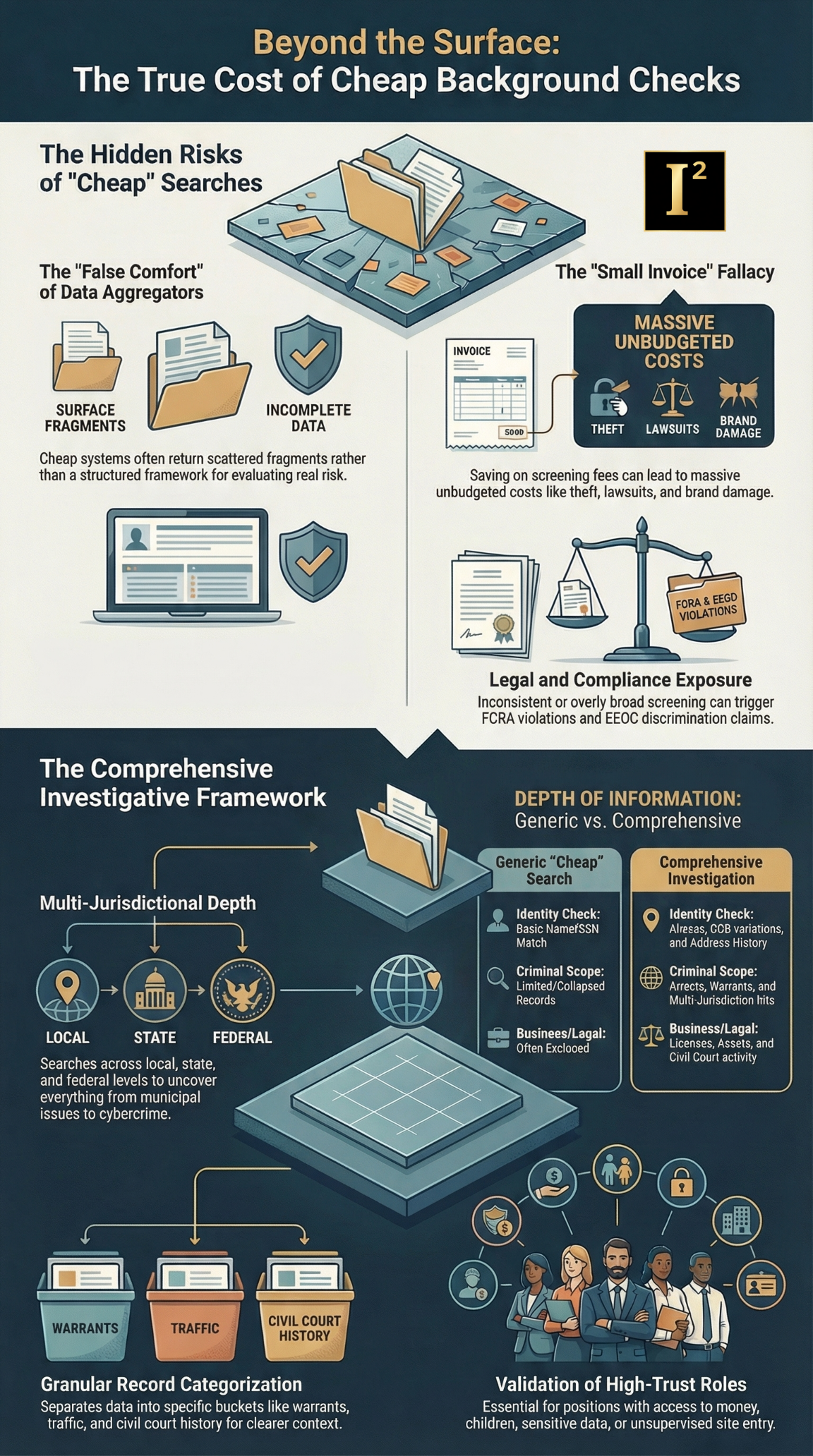
The false comfort of a cheap background check
A lot of companies buy the lowest cost background product because it feels fast, modern, and easy. The sales pitch is usually the same. Type in a name, get a report, check a box, move on.
That is where the problem starts.
Cheap systems often act more like data aggregators than investigative tools. They can return scattered address history, possible relatives, some phone numbers, and limited record hits, but they often do not give employers a strong framework for evaluating risk. By contrast, the report structure reviewed here is built around categories that matter in an actual investigation, including aliases, other dates of birth, other Social Security number variations, businesses, workplaces, professional licenses, court records, arrests, traffic records, sex offender search results, and national warrants.
That difference matters because a hiring decision is not a trivia question. It is a risk decision.
What a comprehensive background review does differently
At Insight Investigations, we do not treat background work like a commodity. We treat it like due diligence.
A more comprehensive review helps expose patterns that a cheap search can miss. It connects identity variations to broader record categories. It helps separate weak associations from meaningful leads. It gives an employer a structured way to look at local record exposure, state level issues, multi jurisdiction activity, business ties, property ties, court history, and criminal history in a more useful format. In the report structure at issue, criminal related sections are not collapsed into one vague bucket. They are separated into arrest records, criminal records, sex offender search, traffic records, and national warrants, alongside court related categories such as evictions, foreclosures, marriage records, and divorce records.
That does not mean every record is disqualifying. It means the employer has a better chance of spotting what deserves closer review.
Why cheap systems create real exposure
The danger with a cheap system is not only what it shows. The real danger is what it fails to show, what it mislabels, or what it gives you without context.
When employers use background reports for hiring, the Fair Credit Reporting Act applies to consumer reports used for employment decisions, including criminal records and other character related information. Employers must follow specific steps before getting the report and before taking adverse action based on it.
At the same time, the EEOC makes clear that employers can use criminal background information, but they cannot use it in a way that violates federal anti discrimination law. The agency warns employers against blanket exclusions and encourages individualized assessment tied to the job and the nature of the record.
So the risk cuts both ways. If your screening is too weak, you may miss serious issues. If your screening process is sloppy, inconsistent, or overly broad, you may create compliance problems of your own.
The hiring liability nobody wants to explain after the fact
Companies usually think about hiring in terms of filling a role. They should also think about hiring in terms of foreseeable harm.
An employee with a serious undiscovered criminal history may create exposure well beyond poor job performance. Depending on the role, a bad hire can lead to workplace violence, theft, fraud, harassment, access abuse, customer harm, data misuse, or regulatory fallout. Courts in different jurisdictions treat negligent hiring claims differently, but the general idea is familiar. If an employer knew or reasonably should have known about a risk and failed to act with reasonable care, liability can follow. That general negligence principle appears across employment liability doctrine, even though the exact standard depends on the facts and the jurisdiction.
That is why local, state, and federal criminal exposure matters.
A city level record may reveal a local arrest or municipal court issue that speaks to recent conduct. A state level record may point to broader prosecution history, probation issues, or repeat conduct across counties. A federal record may reveal conduct with a very different level of seriousness, such as fraud, conspiracy, public corruption, cybercrime, interstate trafficking, or other offenses with major trust implications. A generic search that misses one of those layers may leave the employer making a decision with false confidence. This is an inference drawn from how criminal records are distributed across separate jurisdictions and from the report structure’s use of multiple criminal record categories, not a claim that every search product will miss the same things.
Why this matters even more for trust based roles
The higher the trust, the greater the damage from a weak background process.
A cashier can steal.
A driver can put the public at risk.
A caregiver can abuse access.
A finance employee can commit fraud.
An IT administrator can exfiltrate data.
A cleared contractor can create mission risk.
A field technician can walk straight into homes, schools, plants, or secure sites.
The issue is not fear. The issue is fit, access, and foreseeable exposure.
When the role carries money access, child access, elder access, customer access, controlled information access, network access, or unsupervised site access, a generic search is often the wrong place to save money.
The cost of a cheap check is never just the invoice
A cheap background product looks inexpensive because the invoice is small.
The real cost shows up later in places employers do not budget for:
bad hires,
high turnover,
internal theft,
customer complaints,
brand damage,
insurance headaches,
legal spend,
management distraction,
and crisis response.
One bad hire can wipe out years of “savings” from using a bargain screening tool.
This is where companies make a serious mistake. They compare the price of a stronger investigation to the price of a cheap online search. They should be comparing it to the cost of one preventable failure.
Comprehensive does not mean reckless
A smarter background process is not about rejecting everyone with a record. It is about making better decisions with better facts.
The FTC states that employment background reports are consumer reports under the FCRA when used to determine employment eligibility, and employers must provide disclosures, obtain written permission, and follow adverse action procedures when applicable.
The EEOC also warns that an arrest alone does not establish criminal conduct and that employers should evaluate whether the conduct is relevant to the position. The agency points employers toward job related, business necessity based analysis instead of broad automatic disqualification.
That is the right way to do this. Stronger screening should lead to smarter judgment, not lazy judgment.
How Insight Investigations approaches the problem
At Insight Investigations, we believe background work should help employers ask better questions before they make a risky decision.
That means looking beyond a thin consumer search and using a more structured review that can surface:
identity variations,
alias issues,
address patterns,
associate relationships,
business connections,
license information,
court activity,
and criminal record categories that deserve closer scrutiny. The report framework reviewed here shows exactly why that structure matters. It is designed around investigative categories, not just generic lookup results.
In plain English, we do not want our clients relying on a search result that looks official but leaves them blind.
Final word
A cheap background check is often purchased for convenience. A comprehensive background check is purchased for judgment.
Those are not the same thing.
If your company is hiring for trust, access, safety, money, data, or public facing responsibility, the question is not whether you can afford a better background process. The question is whether you can afford the consequences of a weak one.
Insight Investigations is built for companies that do not want to learn that lesson the hard way.
Important note
This article is for informational purposes only and is not legal advice. Hiring decisions involving criminal history should be reviewed in light of the FCRA, EEOC guidance, and applicable state and local laws.